1.0 ADBox test execution results
1.1 TCER: Deploy ADBox via Docker and shell scripts TRP-001
Relevant test environment and configuration details
- Software deviations: aligned with test case specification, N/A
- Hardware deviations: aligned with test case specification, N/A
- Environment: vm-cyfort-idps-escape
Test execution results
Test case step 1: Clone the ADBox repository — 0 = flawless
Test case step 2: Change the working directory — 0 = flawless
Test case step 3: Build the image — 0 = flawless
Test case step 4: Run the container via shell script — 0 = flawless
Defect summary description
Defect-free test execution, i.e., defect category: 0 = flawless
Text execution evidence
See linked files (if any), e.g., screenshots, logs, etc.
Comments
None
Guide
- Defect category: 0 = flawless; 1 = insignificant defect; 2 = minor defect; 3 = major defect; 4 = critical defect
- Verification method (VM): Test (T), Review of design (R), Inspection (I), Analysis (A)
Parent links: TST-001 Deploy ADBox via Docker and shell scripts
| Attribute | Value |
|---|---|
| test-date | 2024-07-23 |
| tester | AGI |
| defect-category | 0 = flawless |
| passed-steps | 4 |
| failed-steps | 0 |
| not-executed-steps | 0 |
| release-version | 0.1 |
| verification-method | T |
1.2 TCER: Install ADBox as dev container TRP-003
Relevant test environment and configuration details
- Software deviations: aligned with test case specification, N/A
- Hardware deviations: aligned with test case specification, N/A
- Environment: vm-cyfort-idps-escape
Test execution results
The docker build command fails. See reference. Test repeated.
Test case step 4: Open project in dev container in VS Code — 4 = critical defect: dev container build failure — not enough memory
All other steps: 0 = flawless
Defect summary description
Defect category: 4 = critical defect
Dev container build failure — not enough memory (step 4). See referenced screenshot.
Text execution evidence
See tra-003_Dev_container_error.png in assets.
Comments
None
Guide
- Defect category: 0 = flawless; 1 = insignificant defect; 2 = minor defect; 3 = major defect; 4 = critical defect
- Verification method (VM): Test (T), Review of design (R), Inspection (I), Analysis (A)
docs/specs/trp/assets/tra-003_Dev_container_error.png
Parent links: TST-003 Install ADBox as dev container
| Attribute | Value |
|---|---|
| test-date | 2024-07-24 |
| tester | AGI |
| defect-category | 4 = critical defect |
| passed-steps | 5 |
| failed-steps | 1 |
| not-executed-steps | 0 |
| release-version | 0.1 |
| verification-method | T |
1.3 TCER: Install ADBox as dev container TRP-004
Relevant test environment and configuration details
- Software deviations: aligned with test case specification, N/A
- Hardware deviations: aligned with test case specification, N/A
- Environment: vm-cyfort-idps-escape
Test execution results
Container size ~26 GB.
Test case step 6: Run ADBox via its entrypoint — 1 = insignificant defect: entrypoint specification unclear (poetry run adbox required)
All other steps: 0 = flawless
Defect summary description
Defect category: 1 = insignificant defect
Entrypoint specification unclear (change last step: entrypoint poetry run adbox).
Text execution evidence
See linked files (if any), e.g., screenshots, logs, etc.
Comments
None
Guide
- Defect category: 0 = flawless; 1 = insignificant defect; 2 = minor defect; 3 = major defect; 4 = critical defect
- Verification method (VM): Test (T), Review of design (R), Inspection (I), Analysis (A)
Parent links: TST-003 Install ADBox as dev container
| Attribute | Value |
|---|---|
| test-date | 2024-07-24 |
| tester | AGI |
| defect-category | 1 = insignificant defect |
| passed-steps | 5 |
| failed-steps | 1 |
| not-executed-steps | 0 |
| release-version | 0.1 |
| verification-method | T |
1.4 TCER: Run ADBox console TRP-005
Relevant test environment and configuration details
- Software deviations: aligned with test case specification, N/A
- Hardware deviations: aligned with test case specification, N/A
- Environment: vm-cyfort-idps-escape
Test execution results
Test case step 1: Run the siem-mtad-gat-container container in interactive mode — 0 = flawless
Defect summary description
Defect-free test execution, i.e., defect category: 0 = flawless
Text execution evidence
See linked files (if any), e.g., screenshots, logs, etc.
Comments
None
Guide
- Defect category: 0 = flawless; 1 = insignificant defect; 2 = minor defect; 3 = major defect; 4 = critical defect
- Verification method (VM): Test (T), Review of design (R), Inspection (I), Analysis (A)
Parent links: TST-004 Run ADBox console
| Attribute | Value |
|---|---|
| test-date | 2024-07-24 |
| tester | AGI |
| defect-category | 0 = flawless |
| passed-steps | 1 |
| failed-steps | 0 |
| not-executed-steps | 0 |
| release-version | 0.1 |
| verification-method | T |
1.5 TCER: Run ADBox in default mode with a Wazuh connection TRP-006
Relevant test environment and configuration details
- Software deviations: aligned with test case specification, N/A
- Hardware deviations: aligned with test case specification, N/A
- Environment: vm-cyfort-idps-escape
- Wazuh host: 192.168.5.5
Test execution results
Test case step 1: Run the adbox container without any parameters — 0 = flawless
Test case step 2: Input y after the choice prompt for running in default mode — 0 = flawless
Defect summary description
Defect-free test execution, i.e., defect category: 0 = flawless
Text execution evidence
See linked files (if any), e.g., screenshots, logs, etc.
Comments
Suggestion: decrease the number of default epochs.
Guide
- Defect category: 0 = flawless; 1 = insignificant defect; 2 = minor defect; 3 = major defect; 4 = critical defect
- Verification method (VM): Test (T), Review of design (R), Inspection (I), Analysis (A)
Parent links: TST-005 Run ADBox in default mode with a Wazuh connection
| Attribute | Value |
|---|---|
| test-date | 2024-07-25 |
| tester | AGI |
| defect-category | 0 = flawless |
| passed-steps | 2 |
| failed-steps | 0 |
| not-executed-steps | 0 |
| release-version | 0.1 |
| verification-method | T |
1.6 TCER: Run ADBox in default mode without a Wazuh connection TRP-007
Relevant test environment and configuration details
- Software deviations: aligned with test case specification, N/A
- Hardware deviations: aligned with test case specification, N/A
- Environment: vm-cyfort-idps-escape
Test execution results
Test case step 1: Run the AD driver in default mode — 0 = flawless
Test case step 2: Verify offline data loading — 2 = minor defect: offline data not available due to filename mismatch
Output observed:
Running AD driver in default mode.
JSON file 'detector_input_parameters.json' saved at .../detector_models/.../input/detector_input_parameters.json.
Could not establish a connection with OpenSearch.
The file '.../assets/data/train/wazuh-alerts-*.*-2024.07.*.json' does not exist, returning all default data.
Problem with file names:
wazuh-alerts-.-2024.03..json  wazuh-alerts-.-2024.05..json  wazuh-alerts-.-2024.07..json
wazuh-alerts-.-2024.04..json  wazuh-alerts-.-2024.06..json
Defect summary description
Defect category: 2 = minor defect
Offline data not available (filename mismatch).
Text execution evidence
See linked files (if any), e.g., screenshots, logs, etc.
Comments
None
Guide
- Defect category: 0 = flawless; 1 = insignificant defect; 2 = minor defect; 3 = major defect; 4 = critical defect
- Verification method (VM): Test (T), Review of design (R), Inspection (I), Analysis (A)
Parent links: TST-006 Run ADBox in default mode without a Wazuh connection
| Attribute | Value |
|---|---|
| test-date | 2024-07-25 |
| tester | AGI |
| defect-category | 2 = minor defect |
| passed-steps | 1 |
| failed-steps | 1 |
| not-executed-steps | 0 |
| release-version | 0.1 |
| verification-method | T |
1.7 TCER: ADBox use case 1 with a Wazuh connection TRP-008
Relevant test environment and configuration details
- Software deviations: aligned with test case specification, N/A
- Hardware deviations: aligned with test case specification, N/A
- Environment: vm-cyfort-idps-escape
- Wazuh host: 192.168.5.5
Test execution results
Test case step 1: Run adbox with use case scenario 1 — 0 = flawless
Defect summary description
Defect-free test execution, i.e., defect category: 0 = flawless
Text execution evidence
See linked files (if any), e.g., screenshots, logs, etc.
Comments
None
Guide
- Defect category: 0 = flawless; 1 = insignificant defect; 2 = minor defect; 3 = major defect; 4 = critical defect
- Verification method (VM): Test (T), Review of design (R), Inspection (I), Analysis (A)
Parent links: TST-007 ADBox use case 1 with a Wazuh connection
| Attribute | Value |
|---|---|
| test-date | 2024-07-25 |
| tester | AGI |
| defect-category | 0 = flawless |
| passed-steps | 1 |
| failed-steps | 0 |
| not-executed-steps | 0 |
| release-version | 0.1 |
| verification-method | T |
1.8 TCER: ADBox use case 1 without a Wazuh connection TRP-009
Relevant test environment and configuration details
- Software deviations: aligned with test case specification, N/A
- Hardware deviations: aligned with test case specification, N/A
- Environment: vm-cyfort-idps-escape
Test execution results
Test case step 1: Run adbox with use case scenario 1 (no Wazuh connection) — 2 = minor defect: offline data not available due to filename mismatch
Output observed:
Running AD driver in default mode.
JSON file 'detector_input_parameters.json' saved at .../detector_models/.../input/detector_input_parameters.json.
Could not establish a connection with OpenSearch.
The file '.../assets/data/train/wazuh-alerts-*.*-2024.07.*.json' does not exist, returning all default data.
Problem with file names:
wazuh-alerts-.-2024.03..json  wazuh-alerts-.-2024.05..json  wazuh-alerts-.-2024.07..json
wazuh-alerts-.-2024.04..json  wazuh-alerts-.-2024.06..json
Defect summary description
Defect category: 2 = minor defect
Offline data not available (filename mismatch).
Text execution evidence
See linked files (if any), e.g., screenshots, logs, etc.
Comments
None
Guide
- Defect category: 0 = flawless; 1 = insignificant defect; 2 = minor defect; 3 = major defect; 4 = critical defect
- Verification method (VM): Test (T), Review of design (R), Inspection (I), Analysis (A)
Parent links: TST-008 ADBox use case 1 without a Wazuh connection
| Attribute | Value |
|---|---|
| test-date | 2024-07-25 |
| tester | AGI |
| defect-category | 2 = minor defect |
| passed-steps | 0 |
| failed-steps | 1 |
| not-executed-steps | 0 |
| release-version | 0.1 |
| verification-method | T |
1.9 TCER: ADBox use case 2 with a Wazuh connection TRP-010
Relevant test environment and configuration details
- Software deviations: aligned with test case specification, N/A
- Hardware deviations: aligned with test case specification, N/A
- Environment: vm-cyfort-idps-escape
- Wazuh host: 192.168.5.5
Test execution results
Test case step 1: Run adbox with use case scenario 2 — 0 = flawless
Defect summary description
Defect-free test execution, i.e., defect category: 0 = flawless
Text execution evidence
See linked files (if any), e.g., screenshots, logs, etc.
Comments
None
Guide
- Defect category: 0 = flawless; 1 = insignificant defect; 2 = minor defect; 3 = major defect; 4 = critical defect
- Verification method (VM): Test (T), Review of design (R), Inspection (I), Analysis (A)
Parent links: TST-009 ADBox use case 2 with a Wazuh connection
| Attribute | Value |
|---|---|
| test-date | 2024-07-25 |
| tester | AGI |
| defect-category | 0 = flawless |
| passed-steps | 1 |
| failed-steps | 0 |
| not-executed-steps | 0 |
| release-version | 0.1 |
| verification-method | T |
1.10 TCER: ADBox use case 3 with a Wazuh connection TRP-011
Relevant test environment and configuration details
- Software deviations: aligned with test case specification, N/A
- Hardware deviations: aligned with test case specification, N/A
- Environment: vm-cyfort-idps-escape
- Wazuh host: 192.168.5.5
Test execution results
Test case step 1: Run adbox with use case scenario 3 — 0 = flawless
Defect summary description
Defect-free test execution, i.e., defect category: 0 = flawless
Text execution evidence
See linked files (if any), e.g., screenshots, logs, etc.
Comments
None
Guide
- Defect category: 0 = flawless; 1 = insignificant defect; 2 = minor defect; 3 = major defect; 4 = critical defect
- Verification method (VM): Test (T), Review of design (R), Inspection (I), Analysis (A)
Parent links: TST-011 ADBox use case 3 with a Wazuh connection
| Attribute | Value |
|---|---|
| test-date | 2024-07-25 |
| tester | AGI |
| defect-category | 0 = flawless |
| passed-steps | 1 |
| failed-steps | 0 |
| not-executed-steps | 0 |
| release-version | 0.1 |
| verification-method | T |
1.11 TCER: ADBox use case 4 with a Wazuh connection TRP-012
Relevant test environment and configuration details
- Software deviations: aligned with test case specification, N/A
- Hardware deviations: aligned with test case specification, N/A
- Environment: vm-cyfort-idps-escape
- Wazuh host: 192.168.5.5
Test execution results
Test case step 1: Run adbox with use case scenario 4 — 0 = flawless
Defect summary description
Defect-free test execution, i.e., defect category: 0 = flawless
Text execution evidence
See linked files (if any), e.g., screenshots, logs, etc.
Comments
None
Guide
- Defect category: 0 = flawless; 1 = insignificant defect; 2 = minor defect; 3 = major defect; 4 = critical defect
- Verification method (VM): Test (T), Review of design (R), Inspection (I), Analysis (A)
Parent links: TST-013 ADBox use case 4 with a Wazuh connection
| Attribute | Value |
|---|---|
| test-date | 2024-07-25 |
| tester | AGI |
| defect-category | 0 = flawless |
| passed-steps | 1 |
| failed-steps | 0 |
| not-executed-steps | 0 |
| release-version | 0.1 |
| verification-method | T |
1.12 TCER: ADBox use case 5 with a Wazuh connection TRP-013
Relevant test environment and configuration details
- Software deviations: aligned with test case specification, N/A
- Hardware deviations: aligned with test case specification, N/A
- Environment: vm-cyfort-idps-escape
- Wazuh host: 192.168.5.5
Test execution results
Test case step 1: Run adbox with use case scenario 5 — 0 = flawless
Defect summary description
Defect-free test execution, i.e., defect category: 0 = flawless
Text execution evidence
See linked files (if any), e.g., screenshots, logs, etc.
Comments
None
Guide
- Defect category: 0 = flawless; 1 = insignificant defect; 2 = minor defect; 3 = major defect; 4 = critical defect
- Verification method (VM): Test (T), Review of design (R), Inspection (I), Analysis (A)
Parent links: TST-015 ADBox use case 5 with a Wazuh connection
| Attribute | Value |
|---|---|
| test-date | 2024-07-25 |
| tester | AGI |
| defect-category | 0 = flawless |
| passed-steps | 1 |
| failed-steps | 0 |
| not-executed-steps | 0 |
| release-version | 0.1 |
| verification-method | T |
1.13 TCER: ADBox use case 5 without a Wazuh connection TRP-014
Relevant test environment and configuration details
- Software deviations: aligned with test case specification, N/A
- Hardware deviations: aligned with test case specification, N/A
- Environment: vm-cyfort-idps-escape
- Wazuh host: 192.168.5.5
Test execution results
Test case step 1: Run adbox with use case scenario 5 (no Wazuh connection) — 0 = flawless
Defect summary description
Defect-free test execution, i.e., defect category: 0 = flawless
Text execution evidence
See linked files (if any), e.g., screenshots, logs, etc.
Suggestions
For prediction the response should be null if the data are not available.
Comments
None
Guide
- Defect category: 0 = flawless; 1 = insignificant defect; 2 = minor defect; 3 = major defect; 4 = critical defect
- Verification method (VM): Test (T), Review of design (R), Inspection (I), Analysis (A)
Parent links: TST-016 ADBox use case 5 without a Wazuh connection
| Attribute | Value |
|---|---|
| test-date | 2024-07-26 |
| tester | AGI |
| defect-category | 0 = flawless |
| passed-steps | 1 |
| failed-steps | 0 |
| not-executed-steps | 0 |
| release-version | 0.1 |
| verification-method | T |
1.14 TCER: ADBox use case 4 without a Wazuh connection TRP-015
Relevant test environment and configuration details
- Software deviations: aligned with test case specification, N/A
- Hardware deviations: aligned with test case specification, N/A
- Environment: vm-cyfort-idps-escape
- Wazuh host: 192.168.5.5
Test execution results
Test case step 1: Run adbox with use case scenario 4 (no Wazuh connection) — 0 = flawless
Defect summary description
Defect-free test execution, i.e., defect category: 0 = flawless
Text execution evidence
See linked files (if any), e.g., screenshots, logs, etc.
Suggestions
For prediction the response should be null if the data are not available.
Comments
None
Guide
- Defect category: 0 = flawless; 1 = insignificant defect; 2 = minor defect; 3 = major defect; 4 = critical defect
- Verification method (VM): Test (T), Review of design (R), Inspection (I), Analysis (A)
Parent links: TST-014 ADBox use case 4 without a Wazuh connection
| Attribute | Value |
|---|---|
| test-date | 2024-07-26 |
| tester | AGI |
| defect-category | 0 = flawless |
| passed-steps | 1 |
| failed-steps | 0 |
| not-executed-steps | 0 |
| release-version | 0.1 |
| verification-method | T |
1.15 TCER: ADBox use case 3 without a Wazuh connection TRP-016
Relevant test environment and configuration details
- Software deviations: aligned with test case specification, N/A
- Hardware deviations: aligned with test case specification, N/A
- Environment: vm-cyfort-idps-escape
- Wazuh host: 192.168.5.5
Test execution results
Test case step 1: Run adbox with use case scenario 3 (no Wazuh connection) — 0 = flawless
Defect summary description
Defect-free test execution, i.e., defect category: 0 = flawless
Text execution evidence
See linked files (if any), e.g., screenshots, logs, etc.
Comments
None
Guide
- Defect category: 0 = flawless; 1 = insignificant defect; 2 = minor defect; 3 = major defect; 4 = critical defect
- Verification method (VM): Test (T), Review of design (R), Inspection (I), Analysis (A)
Parent links: TST-012 ADBox use case 3 without a Wazuh connection
| Attribute | Value |
|---|---|
| test-date | 2024-07-26 |
| tester | AGI |
| defect-category | 0 = flawless |
| passed-steps | 1 |
| failed-steps | 0 |
| not-executed-steps | 0 |
| release-version | 0.1 |
| verification-method | T |
1.16 TCER: ADBox use case 2 without a Wazuh connection TRP-017
Relevant test environment and configuration details
- Software deviations: aligned with test case specification, N/A
- Hardware deviations: aligned with test case specification, N/A
- Environment: vm-cyfort-idps-escape
- Wazuh host: 192.168.5.5
Test execution results
Test case step 1: Run adbox with use case scenario 2 (no Wazuh connection) — 0 = flawless
Defect summary description
Defect-free test execution, i.e., defect category: 0 = flawless
Text execution evidence
See linked files (if any), e.g., screenshots, logs, etc.
Suggestions
For prediction the response should be null if the data are not available.
Comments
None
Guide
- Defect category: 0 = flawless; 1 = insignificant defect; 2 = minor defect; 3 = major defect; 4 = critical defect
- Verification method (VM): Test (T), Review of design (R), Inspection (I), Analysis (A)
Parent links: TST-010 ADBox use case 2 without a Wazuh connection
| Attribute | Value |
|---|---|
| test-date | 2024-07-26 |
| tester | AGI |
| defect-category | 0 = flawless |
| passed-steps | 1 |
| failed-steps | 0 |
| not-executed-steps | 0 |
| release-version | 0.1 |
| verification-method | T |
1.17 TCER: ADBox use case 1 without a Wazuh connection TRP-018
Relevant test environment and configuration details
- Software deviations: aligned with test case specification, N/A
- Hardware deviations: aligned with test case specification, N/A
- Environment: vm-cyfort-idps-escape
- Wazuh host: 192.168.5.5
Test execution results
Test case step 1: Run adbox with use case scenario 1 (no Wazuh connection) — 0 = flawless
Defect summary description
Defect-free test execution, i.e., defect category: 0 = flawless
Text execution evidence
See linked files (if any), e.g., screenshots, logs, etc.
Comments
None
Guide
- Defect category: 0 = flawless; 1 = insignificant defect; 2 = minor defect; 3 = major defect; 4 = critical defect
- Verification method (VM): Test (T), Review of design (R), Inspection (I), Analysis (A)
Parent links: TST-008 ADBox use case 1 without a Wazuh connection
| Attribute | Value |
|---|---|
| test-date | 2024-07-26 |
| tester | AGI |
| defect-category | 0 = flawless |
| passed-steps | 1 |
| failed-steps | 0 |
| not-executed-steps | 0 |
| release-version | 0.1 |
| verification-method | T |
1.18 TCER: Run ADBox in default mode without a Wazuh connection TRP-019
Relevant test environment and configuration details
- Software deviations: aligned with test case specification, N/A
- Hardware deviations: aligned with test case specification, N/A
- Environment: vm-cyfort-idps-escape
- Wazuh host: 192.168.5.5
Test execution results
Test case step 1: Run the adbox container without any parameters — 0 = flawless
Test case step 2: Input y after the choice prompt for running in default mode — 0 = flawless
Defect summary description
Defect-free test execution, i.e., defect category: 0 = flawless
Text execution evidence
See linked files (if any), e.g., screenshots, logs, etc.
Comments
None
Guide
- Defect category: 0 = flawless; 1 = insignificant defect; 2 = minor defect; 3 = major defect; 4 = critical defect
- Verification method (VM): Test (T), Review of design (R), Inspection (I), Analysis (A)
Parent links: TST-006 Run ADBox in default mode without a Wazuh connection
| Attribute | Value |
|---|---|
| test-date | 2024-07-26 |
| tester | AGI |
| defect-category | 0 = flawless |
| passed-steps | 2 |
| failed-steps | 0 |
| not-executed-steps | 0 |
| release-version | 0.1 |
| verification-method | T |
1.19 TCER: Install ADBox as dev container TRP-020
Relevant test environment and configuration details
- Software deviations: aligned with test case specification, N/A
- Hardware deviations: aligned with test case specification, N/A
- Environment: vm-cyfort-idps-escape
Test execution results
Test case step 1: Clone the repo — 0 = flawless
Test case step 2: Start Docker Desktop — 0 = flawless
Test case step 3: Open project folder in VS Code — 0 = flawless
Test case step 4: Open project in dev container in VS Code — 0 = flawless
Test case step 5: Run poetry install in the container — 0 = flawless
Test case step 6: Run ADBox via its entrypoint — 0 = flawless
Defect summary description
Defect-free test execution, i.e., defect category: 0 = flawless
Text execution evidence
See linked files (if any), e.g., screenshots, logs, etc.
Comments
None
Guide
- Defect category: 0 = flawless; 1 = insignificant defect; 2 = minor defect; 3 = major defect; 4 = critical defect
- Verification method (VM): Test (T), Review of design (R), Inspection (I), Analysis (A)
Parent links: TST-003 Install ADBox as dev container
| Attribute | Value |
|---|---|
| test-date | 2024-07-29 |
| tester | AGI |
| defect-category | 0 = flawless |
| passed-steps | 6 |
| failed-steps | 0 |
| not-executed-steps | 0 |
| release-version | 0.1 |
| verification-method | T |
1.20 TCER: ADBox shipping install TRP-022
Relevant test environment and configuration details
- Software deviations: aligned with test case specification, with controller node running Ubuntu 22.04.5 LTS (Jammy Jellyfish)
- Hardware deviations: aligned with test case specification (VMs handled via QEMU KVM hypervisor)
Test execution results
Here we report the results in terms of step-wise alignments or deviations with respect to the expected outcome of the covered test case.
Test case step 1: Running the container with the -s flag
- 0 = flawless
Defect summary description
Defect-free test execution, i.e., defect category: 0 = flawless
Text execution evidence
See linked files (if any), e.g., screenshots, logs, etc.
Comments
N/A
Guide
- Defect category: 0 = flawless; 1 = insignificant defect; 2 = minor defect; 3 = major defect; 4 = critical defect
- Verification method (VM): Test (T), Review of design (R), Inspection (I), Analysis (A)
Parent links: TST-017 ADBox shipping install
| Attribute | Value |
|---|---|
| test-date | 2024-12-10 |
| tester | AAT |
| defect-category | 0 = flawless |
| passed-steps | 1 |
| failed-steps | 0 |
| not-executed-steps | 0 |
| release-version | 0.3 |
| verification-method | T |
1.21 TCER: ADBox deployment TRP-023
Relevant test environment and configuration details
- Software deviations: aligned with test case specification, with controller node running Ubuntu 22.04.5 LTS (Jammy Jellyfish)
- Hardware deviations: aligned with test case specification (VMs handled via QEMU KVM hypervisor)
Test execution results
Test case step 1: Clone the repo — 0 = flawless
Test case step 2: Change directory — 0 = flawless
Test case step 3: Build the image — 0 = flawless
Test case step 4: Make the container executable and run it — 0 = flawless
Defect summary description
Defect-free test execution, i.e., defect category: 0 = flawless
Text execution evidence
See linked files (if any), e.g., screenshots, logs, etc.
Comments
N/A
Guide
- Defect category: 0 = flawless; 1 = insignificant defect; 2 = minor defect; 3 = major defect; 4 = critical defect
- Verification method (VM): Test (T), Review of design (R), Inspection (I), Analysis (A)
Parent links: TST-001 Deploy ADBox via Docker and shell scripts
| Attribute | Value |
|---|---|
| test-date | 2025-01-17 |
| tester | AAT |
| defect-category | 0 = flawless |
| passed-steps | 4 |
| failed-steps | 0 |
| not-executed-steps | 0 |
| release-version | 0.3 |
| verification-method | T |
1.22 TCER: ADBox in dev container TRP-024
Relevant test environment and configuration details
- Software deviations: aligned with test case specification, with controller node running Ubuntu 22.04.5 LTS (Jammy Jellyfish)
- Hardware deviations: aligned with test case specification (VMs handled via QEMU KVM hypervisor)
Test execution results
Test case step 1: Clone the repo — 0 = flawless
Test case step 2: Start Docker Desktop — 0 = flawless
Test case step 3: Open project folder in VS Code — 0 = flawless
Test case step 4: Open project in dev container in VS Code — 0 = flawless
Test case step 5: Run poetry install in the container — 0 = flawless
Test case step 6: Run ADBox via its entrypoint — 0 = flawless
Defect summary description
Defect-free test execution, i.e., defect category: 0 = flawless
Text execution evidence / Comments — N/A
Guide
- Defect category: 0 = flawless; 1 = insignificant defect; 2 = minor defect; 3 = major defect; 4 = critical defect
- Verification method (VM): Test (T), Review of design (R), Inspection (I), Analysis (A)
Parent links: TST-003 Install ADBox as dev container
| Attribute | Value |
|---|---|
| test-date | 2025-01-17 |
| tester | AAT |
| defect-category | 0 = flawless |
| passed-steps | 6 |
| failed-steps | 0 |
| not-executed-steps | 0 |
| release-version | 0.3 |
| verification-method | T |
1.23 TCER: ADBox console TRP-025
Relevant test environment and configuration details
- Software deviations: aligned with test case specification, with controller node running Ubuntu 22.04.5 LTS (Jammy Jellyfish)
- Hardware deviations: aligned with test case specification (VMs handled via QEMU KVM hypervisor)
Test execution results
Test case step 1: Run the siem-mtad-gat-container container in interactive mode — 0 = flawless
Defect summary description
Defect-free test execution, i.e., defect category: 0 = flawless
Text execution evidence / Comments — N/A
Guide
- Defect category: 0 = flawless; 1 = insignificant defect; 2 = minor defect; 3 = major defect; 4 = critical defect
- Verification method (VM): Test (T), Review of design (R), Inspection (I), Analysis (A)
Parent links: TST-004 Run ADBox console
| Attribute | Value |
|---|---|
| test-date | 2025-01-17 |
| tester | AAT |
| defect-category | 0 = flawless |
| passed-steps | 1 |
| failed-steps | 0 |
| not-executed-steps | 0 |
| release-version | 0.3 |
| verification-method | T |
1.24 TCER: ADBox in default mode with Wazuh TRP-026
Relevant test environment and configuration details
- Software deviations: aligned with test case specification, with controller node running Ubuntu 22.04.5 LTS (Jammy Jellyfish)
- Hardware deviations: aligned with test case specification (VMs handled via QEMU KVM hypervisor)
Test execution results
Test case step 1: Run the adbox container without any parameters — 0 = flawless
Test case step 2: Input y after the choice prompt for running in default mode — 0 = flawless
Defect summary description
Defect-free test execution, i.e., defect category: 0 = flawless
Text execution evidence / Comments — N/A
Guide
- Defect category: 0 = flawless; 1 = insignificant defect; 2 = minor defect; 3 = major defect; 4 = critical defect
- Verification method (VM): Test (T), Review of design (R), Inspection (I), Analysis (A)
Parent links: TST-005 Run ADBox in default mode with a Wazuh connection
| Attribute | Value |
|---|---|
| test-date | 2025-01-22 |
| tester | AAT |
| defect-category | 0 = flawless |
| passed-steps | 2 |
| failed-steps | 0 |
| not-executed-steps | 0 |
| release-version | 0.3 |
| verification-method | T |
1.25 TCER: ADBox UC scenario 2 with Wazuh TRP-027
Relevant test environment and configuration details
- Software deviations: aligned with test case specification, with controller node running Ubuntu 22.04.5 LTS (Jammy Jellyfish)
- Hardware deviations: aligned with test case specification (VMs handled via QEMU KVM hypervisor)
Test execution results
Test case step 1: Run adbox with use case scenario number 2 — 0 = flawless
Defect summary description
Defect-free test execution, i.e., defect category: 0 = flawless
Text execution evidence / Comments — N/A
Guide
- Defect category: 0 = flawless; 1 = insignificant defect; 2 = minor defect; 3 = major defect; 4 = critical defect
- Verification method (VM): Test (T), Review of design (R), Inspection (I), Analysis (A)
Parent links: TST-009 ADBox use case 2 with a Wazuh connection
| Attribute | Value |
|---|---|
| test-date | 2025-01-23 |
| tester | AAT |
| defect-category | 0 = flawless |
| passed-steps | 1 |
| failed-steps | 0 |
| not-executed-steps | 0 |
| release-version | 0.3 |
| verification-method | T |
1.26 TCER: ADBox UC scenario 3 with Wazuh TRP-028
Relevant test environment and configuration details
- Software deviations: aligned with test case specification, with controller node running Ubuntu 22.04.5 LTS (Jammy Jellyfish)
- Hardware deviations: aligned with test case specification (VMs handled via QEMU KVM hypervisor)
Test execution results
Test case step 1: Run adbox with use case scenario number 3 — 0 = flawless
Defect summary description
Defect-free test execution, i.e., defect category: 0 = flawless
Text execution evidence / Comments — N/A
Guide
- Defect category: 0 = flawless; 1 = insignificant defect; 2 = minor defect; 3 = major defect; 4 = critical defect
- Verification method (VM): Test (T), Review of design (R), Inspection (I), Analysis (A)
Parent links: TST-011 ADBox use case 3 with a Wazuh connection
| Attribute | Value |
|---|---|
| test-date | 2025-01-23 |
| tester | AAT |
| defect-category | 0 = flawless |
| passed-steps | 1 |
| failed-steps | 0 |
| not-executed-steps | 0 |
| release-version | 0.3 |
| verification-method | T |
2.0 RADAR test case execution results
2.1 TCER: Setup RADAR foundation TRP-030
Relevant test environment and configuration details
- Software deviations: aligned with test case specification, with controller node running Ubuntu 22.04.5 LTS (Jammy Jellyfish)
- Hardware deviations: aligned with test case specification (VMs handled via QEMU KVM hypervisor)
Test execution results
Here we report the results in terms of step-wise alignments or deviations with respect to the expected outcome of the covered test case.
Test case step 1: Verify working directory availability
- 0 = flawless:
radardirectory available.
Test case step 2: Verify configuration of .env file
- 0 = flawless: available as indicated in the test case specification.
Test case step 3: Verify Ansible configuration, setup and reachability
- 0 = flawless: remote agent configuration successful
- 0 = flawless: remote manager configuration successful
- 0 = flawless: vault creation and setup for agent and manager successful
- 0 = flawless: sudo setup for access to controlled node successful
- 0 = flawless: Ansible reaching nodes in the SSH group successful
Test case step 4: Verify creation and setup of SSL/TLS certificates
- 0 = flawless: certificates created and stored under
config/wazuh_indexer_ssl_certs/
Defect summary description
0 = flawless
Text execution evidence
See linked files (if any), e.g., screenshots, logs, etc.
Comments
Any additional informative details not fitting in the above sections.
Guide
- Defect category: 0 = flawless; 1 = insignificant defect; 2 = minor defect; 3 = major defect; 4 = critical defect
- Verification method (VM): Test (T), Review of design (R), Inspection (I), Analysis (A)
Parent links: TST-041 Setup RADAR foundation
| Attribute | Value |
|---|---|
| test-date | 2026-03-10 |
| tester | DMA |
| defect-category | 0 = flawless |
| passed-steps | 4 |
| failed-steps | 0 |
| not-executed-steps | 0 |
| release-version | 0.8 |
| verification-method | T |
2.2 TCER: Build suspicious login TRP-031
Relevant test environment and configuration details
- Software deviations: aligned with test case specification, with controller node running Ubuntu 22.04.5 LTS (Jammy Jellyfish)
- Hardware deviations: aligned with test case specification (VMs handled via QEMU KVM hypervisor)
Test execution results
Here we report the results in terms of step-wise alignments or deviations with respect to the expected outcome of the covered test case. The executed command was as follows:
sudo ./build-radar.sh suspicious_login --agent remote --manager local --manager_exists false
In Wazuh Manager
Test case step 2.1: Custom 0310 SSH decoder deployed
- 0 = flawless:
0310-ssh.xmlexists, and is owned byroot:wazuh, with mode0640.
Test case step 2.2: Custom 0310 SSH decoder contains RADAR fields
- 0 = flawless: decoder contains the decoders
sshd-*-with-radar(e.g., including RADAR fields likeASN,country,geo_velocity).
Test case step 2.3: Default 0310 decoder is excluded in ossec.conf
- 0 = flawless: a
<decoder_exclude>0310-ssh_decoders.xml</decoder_exclude>line appears (ideally once) under<ruleset>.
Test case step 2.4: RADAR rules for suspicious_login are in /var/ossec/etc/rules/
- 0 = flawless:
a3-suspicious-login.xmlexists with ownerroot:wazuh, mode0640.
Test case step 2.5: Suspicious login rules are bound to active responses
- 0 = flawless: suspicious login rule ID(s) reference the intended
<active-response>triggeringradar_ar.py.
Test case step 2.6: Agent is registered with the manager
- 0 = flawless: an entry exists for each agent.
Test case step 2.7: Agent configurations are in place
- 0 = flawless: agent configurations for suspicious login exist in the
<!-- RADAR: suspicious_login agent_config -->block.
Test case step 2.8: Wazuh Manager is running after restart
- 0 = flawless: the status output indicates the manager is
runningwith no error messages.
In endpoints running agents
Test case step 2.9: RADAR helper directory and script are installed on the SSH agent host
- 0 = flawless:
/opt/radarexists with mode0755and ownerroot:root;radar-helper.pyexists with mode0750and ownerroot:root.
Test case step 2.10: radar-helper.service systemd unit is installed, enabled, and running
- 0 = flawless: the service is active.
Post-test cleanup
Test case step 3: Check the cleanup after successful validations, the command output should be empty
- 0 = flawless: The command output is empty.
Defect summary description
0 = flawless
Text execution evidence
See linked files (if any), e.g., screenshots, logs, etc.
Comments
Any additional informative details not fitting in the above sections.
Guide
- Defect category: 0 = flawless; 1 = insignificant defect; 2 = minor defect; 3 = major defect; 4 = critical defect
- Verification method (VM): Test (T), Review of design (R), Inspection (I), Analysis (A)
Parent links: TST-042 Build suspicious login
| Attribute | Value |
|---|---|
| test-date | 2026-03-10 |
| tester | DMA |
| defect-category | 0 = flawless |
| passed-steps | 11 |
| failed-steps | 0 |
| not-executed-steps | 0 |
| release-version | 0.8 |
| verification-method | T |
2.3 TCER: Build non-whitelist GeoIP detection TRP-032
Relevant test environment and configuration details
- Software deviations: aligned with test case specification, with controller node running Ubuntu 22.04.5 LTS (Jammy Jellyfish)
- Hardware deviations: aligned with test case specification (VMs handled via QEMU KVM hypervisor)
Test execution results
Here we report the results in terms of step-wise alignments or deviations with respect to the expected outcome of the covered test case. The executed command was as follows:
./build-radar.sh geoip_detection --agent remote/local --manager remote/local --manager_exists true/false
In Wazuh Manager
Test case step 2.1: Whitelist file exists
- 0 = flawless:
/var/ossec/etc/lists/whitelist_countriesexists, its contents match the scenario'swhitelist_countries, and its owner isroot:wazuh, with mode0664.
Test case step 2.2: ossec.conf has <list> entry for whitelist_countries
- 0 = flawless: under
<ruleset>, there is a<list>...whitelist_countries</list>entry with the RADAR marker forgeoip_detection.
Test case step 2.3: Custom 0310 SSH decoder deployed
- 0 = flawless:
0310-ssh.xmlexists, and is owned byroot:wazuh, mode0640.
Test case step 2.4: Default 0310 decoder is excluded in ossec.conf
- 0 = flawless: a
<decoder_exclude>0310-ssh_decoders.xml</decoder_exclude>line appears (ideally once) under<ruleset>.
Test case step 2.5: RADAR rules for geoip_detection exist
- 0 = flawless:
a2-geoip-detection.xmlcontains aRADAR_RULES: geoip_detectionblock; rules usewhitelist_countriesto detect non-whitelisted countries.
Test case step 2.6: GeoIP non-whitelist rules are bound to active responses
- 0 = flawless: GeoIP non-whitelist rule ID(s) reference the correct
<active-response>.
Test case step 2.7: Active response config files are in place
- 0 = flawless:
ar.yamlandradar_ar.pypresent in/var/ossec/active-response/bin/.
Test case step 2.8: Agent configurations are in place
- 0 = flawless: agent configurations for geoip detection exist.
In endpoints running agents
Test case step 2.9: RADAR helper directory and script are installed on the SSH agent host
- 0 = flawless:
/opt/radarexists with mode0755and ownerroot:root;radar-helper.pyexists with mode0750and ownerroot:root.
Test case step 2.10: radar-helper.service systemd unit is installed, enabled, and running
- 0 = flawless: the service is active.
Post-test cleanup
Test case step 3: Check the cleanup after successful validations, the command output should be empty
- 0 = flawless: The command output is empty.
Defect summary description
0 = flawless
Text execution evidence
See linked files (if any), e.g., screenshots, logs, etc.
Comments
Any additional informative details not fitting in the above sections.
Guide
- Defect category: 0 = flawless; 1 = insignificant defect; 2 = minor defect; 3 = major defect; 4 = critical defect
- Verification method (VM): Test (T), Review of design (R), Inspection (I), Analysis (A)
Parent links: TST-043 Build non-whitelist GeoIP detection
| Attribute | Value |
|---|---|
| test-date | 2026-03-10 |
| tester | DMA |
| defect-category | 0 = flawless |
| passed-steps | 11 |
| failed-steps | 0 |
| not-executed-steps | 0 |
| release-version | 0.8 |
| verification-method | T |
2.4 TCER: Build log volume abnormal growth TRP-033
Relevant test environment and configuration details
- Software deviations: aligned with test case specification, with controller node running Ubuntu 22.04.5 LTS (Jammy Jellyfish)
- Hardware deviations: aligned with test case specification (VMs handled via QEMU KVM hypervisor)
Test execution results
Here we report the results in terms of step-wise alignments or deviations with respect to the expected outcome of the covered test case. The executed command was as follows:
./build-radar.sh log_volume --agent remote/local --manager remote/local --manager_exists true/false
In Wazuh Manager
Test case step 2.1: RADAR snippet for log_volume is present in ossec.conf
- 0 = flawless:
ossec.confcontains aRADAR: log_volume BEGIN/ENDblock with the log volume-related settings.
Test case step 2.2: RADAR decoders for log_volume exist
- 0 = flawless:
0001-log-volume.xmlcontains a block defining decoders that produce alog_bytesfield.
Test case step 2.3: RADAR rules for log_volume exist
- 0 = flawless:
a1-log-volume.xmlexists in/var/ossec/etc/rules.
Test case step 2.4: OpenSearch template radar-log-volume is present
- 0 = flawless: HTTP status is
200and the template JSON exists with mappings forlog_bytesas a numeric type.
Test case step 2.5: log_volume rules are bound to active responses
- 0 = flawless: log volume anomaly rule ID(s) reference
radar_ar.pyas intended.
Test case step 2.6: Agent configurations are in place
- 0 = flawless: agent configurations for log volume exist.
In endpoints running agents
Test case step 2.7: RADAR helper directory and script are installed on the SSH agent host
- 0 = flawless:
/opt/radarexists with mode0755and ownerroot:root;radar-helper.pyexists with mode0750and ownerroot:root.
Test case step 2.8: radar-helper.service systemd unit is installed, enabled, and running
- 0 = flawless: the service is active.
Post-test cleanup
Test case step 3: Check the cleanup after successful validations, the command output should be empty
- 0 = flawless: The command output is empty.
Defect summary description
0 = flawless
Text execution evidence
See linked files (if any), e.g., screenshots, logs, etc.
Comments
Any additional informative details not fitting in the above sections.
Guide
- Defect category: 0 = flawless; 1 = insignificant defect; 2 = minor defect; 3 = major defect; 4 = critical defect
- Verification method (VM): Test (T), Review of design (R), Inspection (I), Analysis (A)
Parent links: TST-044 Build log volume abnormal growth
| Attribute | Value |
|---|---|
| test-date | 2026-03-10 |
| tester | DMA |
| defect-category | 0 = flawless |
| passed-steps | 9 |
| failed-steps | 0 |
| not-executed-steps | 0 |
| release-version | 0.8 |
| verification-method | T |
2.5 TCER: Run RADAR for log volume abnormal growth TRP-034
Relevant test environment and configuration details
- Software deviations: aligned with test case specification, with controller node running Ubuntu 22.04.5 LTS (Jammy Jellyfish)
- Hardware deviations: aligned with test case specification (VMs handled via QEMU KVM hypervisor)
Test execution results
Here we report the results in terms of step-wise alignments or deviations with respect to the expected outcome of the covered test case. The executed command was as follows:
./run-radar.sh log_volume
In Wazuh Dashboard
Test case step 2.1: The detector LOG_VOLUME_DETECTOR is created in the Wazuh Dashboard with the correct configurations
- 0 = flawless: In the Anomaly Detection menu, the created detector is visible. The expected configurations are found in
config.yamlunder thelog_volumekey.
Test case step 2.2: Monitor creation and trigger to webhook existence
- 0 = flawless: the monitor is created in the Wazuh Dashboard with a trigger to a RADAR webhook instance. In the Alerting menu, the created Monitor is listed under the Monitors tab.
Defect summary description
0 = flawless
Text execution evidence
See linked files (if any), e.g., screenshots, logs, etc.
Comments
Any additional informative details not fitting in the above sections.
Guide
- Defect category: 0 = flawless; 1 = insignificant defect; 2 = minor defect; 3 = major defect; 4 = critical defect
- Verification method (VM): Test (T), Review of design (R), Inspection (I), Analysis (A)
Parent links: TST-045 Run RADAR for log volume abnormal growth
| Attribute | Value |
|---|---|
| test-date | 2026-03-10 |
| tester | DMA |
| defect-category | 0 = flawless |
| passed-steps | 2 |
| failed-steps | 0 |
| not-executed-steps | 0 |
| release-version | 0.8 |
| verification-method | T |
2.6 TCER: DECIPHER-RADAR detection validation for suspicious login TRP-035
Relevant test environment and configuration details
- Software deviations: aligned with test case specification, with controller node running Ubuntu 22.04.5 LTS (Jammy Jellyfish)
- Hardware deviations: aligned with test case specification (VMs handled via QEMU KVM hypervisor)
Test execution results
Here we report the results in terms of step-wise alignments or deviations with respect to the expected outcome of the covered test case. The executed command was as follows:
sudo ./simulate-radar.sh suspicious_login --agent remote
Test case step 2.1: The ansible playbook executes successfully
- 0 = flawless: The simulation was successfully executed.
Test case step 2.2: In the Wazuh Dashboard Discovery page, at least one of rule IDs 210012, 210013, 210020, or 210021 is triggered for the remote agent
- 0 = flawless: Alerts with one of the rule.id : [
210012,210013,210020, or210021] appear in the Wazuh Dashboard.
Test case step 2.3: In Wazuh manager, alert tier verified via grep "Risk computed" /var/ossec/logs/active-responses.log | tail -1
- Tier 0:
- 0 = flawless: no email received at
EMAIL_TO. - 0 = flawless: no FlowIntel case created.
- 0 = flawless: no mitigation command in
/var/ossec/logs/active-responses.log.
- 0 = flawless: no email received at
- Tier 1: (Same alerts were generated, but by putting one of the IPs present in the alert in MISP changed the tier from 0 to 1)
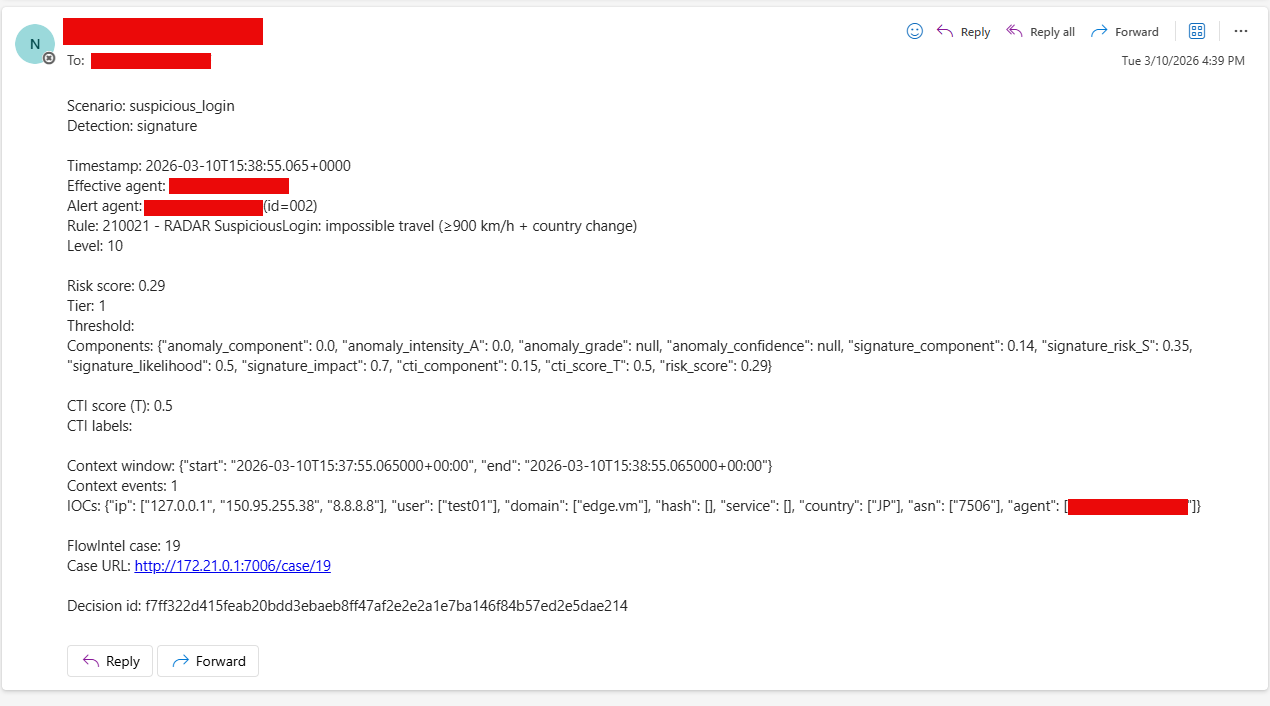
- 0 = flawless: email received at
EMAIL_TOwith risk score, tier, and FlowIntel case URL. - 0 = flawless: FlowIntel case created and accessible at the URL included in the email.
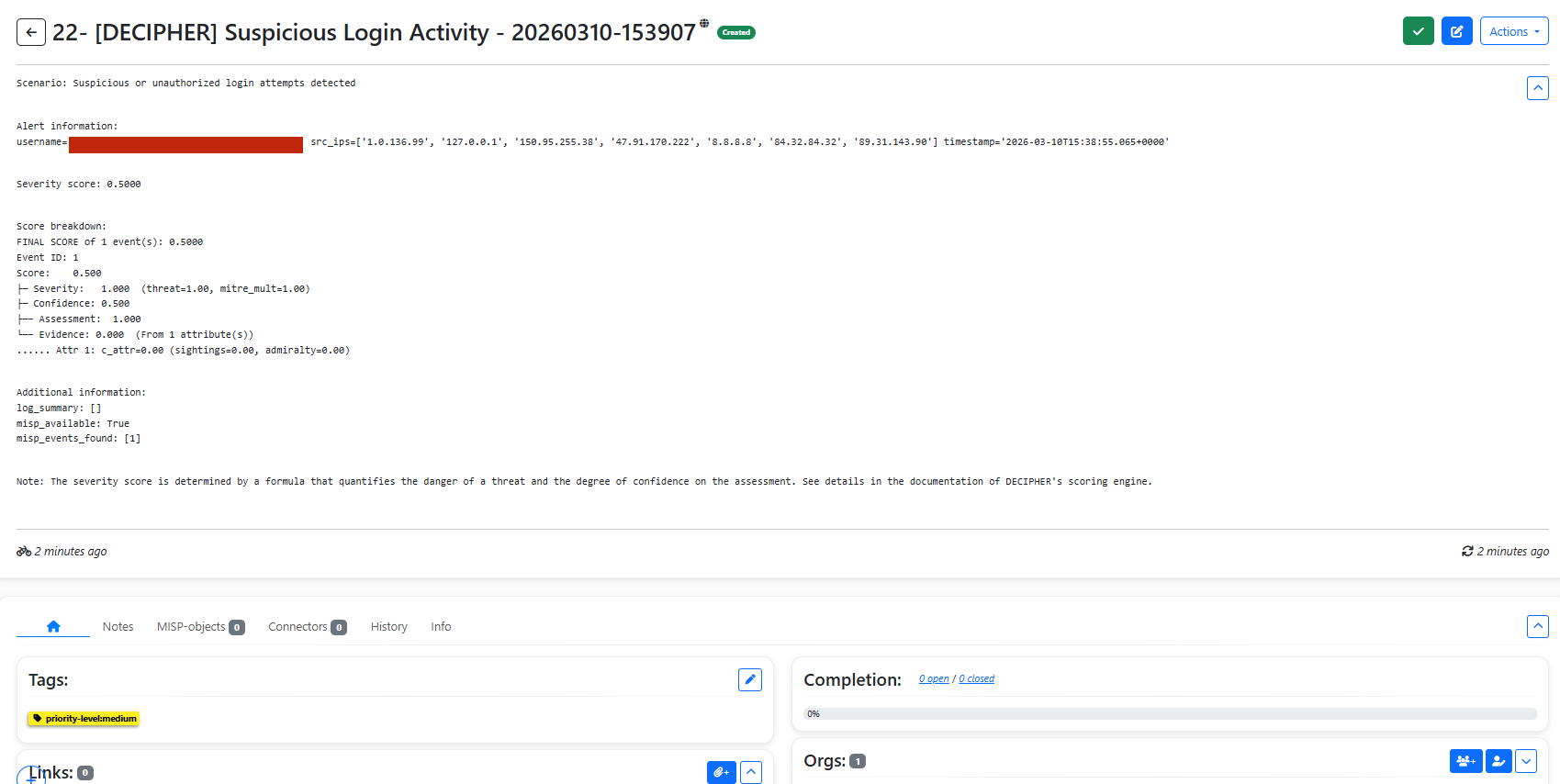
- 0 = flawless: FlowIntel case contains relevant information about the suspicious login event, related events found in MISP, and a breakdown of the risk score including the assigned tier.
- 0 = flawless:
misp_available: trueappears in the FlowIntel case description, confirmed via"DECIPHER analyze completed"log entry matched bydecision_id. - 0 = flawless: FlowIntel case is tagged with low priority.
- 0 = flawless: no mitigation command in
/var/ossec/logs/active-responses.log.
- 0 = flawless: email received at
Defect summary description
0 = flawless
Text execution evidence
FlowIntel case:
Email:
Comments
Any additional informative details not fitting in the above sections.
Guide
- Defect category: 0 = flawless; 1 = insignificant defect; 2 = minor defect; 3 = major defect; 4 = critical defect
- Verification method (VM): Test (T), Review of design (R), Inspection (I), Analysis (A)
Parent links: TST-046 DECIPHER-RADAR detection validation for Suspicious login
| Attribute | Value |
|---|---|
| test-date | 2026-03-10 |
| tester | DMA |
| defect-category | 0 = flawless |
| passed-steps | 3 |
| failed-steps | 0 |
| not-executed-steps | 0 |
| release-version | 0.8 |
| verification-method | T |
2.7 TCER: Detection validation for GeoIP detection TRP-036
Relevant test environment and configuration details
- Software deviations: aligned with test case specification, with controller node running Ubuntu 22.04.5 LTS (Jammy Jellyfish)
- Hardware deviations: aligned with test case specification (VMs handled via QEMU KVM hypervisor)
Test execution results
Here we report the results in terms of step-wise alignments or deviations with respect to the expected outcome of the covered test case. The executed command was as follows:
sudo ./simulate-radar.sh geoip_detection --agent remote
Test case step 2.1: The ansible playbook executes successfully
- 0 = flawless: The ansible playbook executed successfully.
Test case step 2.2: In the Wazuh Dashboard Discovery page, a rule with ID matching 10090* is triggered for the remote agent
- 0 = flawless: A rule with rule.id '100900' was triggered and appeared in Wazuh Dashboard
Test case step 2.3: In Wazuh manager, alert tier verified via grep "Risk computed" /var/ossec/logs/active-responses.log | tail -1
-
Tier 1:
- 0 = flawless: email received at
EMAIL_TOwith risk score, tier. - 0 = flawless: no mitigation command in
/var/ossec/logs/active-responses.log.
- 0 = flawless: email received at
-
Tier 3:
- 0 = flawless: email received at
EMAIL_TOwith risk score, and tier. - 0 = flawless: mitigation commands from
mitigations_tier3forgeoip_detectionappear in/var/ossec/logs/active-responses.log. - 0 = flawless:
firewall-drop: IP address blocked in the agent.
- 0 = flawless: email received at
Defect summary description
0 = flawless
Text execution evidence
See linked files (if any), e.g., screenshots, logs, etc.
Comments
Any additional informative details not fitting in the above sections.
Guide
- Defect category: 0 = flawless; 1 = insignificant defect; 2 = minor defect; 3 = major defect; 4 = critical defect
- Verification method (VM): Test (T), Review of design (R), Inspection (I), Analysis (A)
Parent links: TST-047 Detection validation for GeoIP detection
| Attribute | Value |
|---|---|
| test-date | 2026-03-10 |
| tester | DMA |
| defect-category | 0 = flawless |
| passed-steps | 3 |
| failed-steps | 0 |
| not-executed-steps | 0 |
| release-version | 0.8 |
| verification-method | T |
2.8 TCER: Detection validation for log volume abnormal growth TRP-037
Relevant test environment and configuration details
- Software deviations: aligned with test case specification, with controller node running Ubuntu 22.04.5 LTS (Jammy Jellyfish)
- Hardware deviations: aligned with test case specification (VMs handled via QEMU KVM hypervisor)
Test execution results
Here we report the results in terms of step-wise alignments or deviations with respect to the expected outcome of the covered test case. The executed command was as follows:
./simulate-radar.sh log_volume --agent remote
Test case step 2.1: The ansible playbook executes successfully
- 0 = flawless: The ansible playbook executed successfully.
Test case step 2.2: In the Wazuh Dashboard Discovery page, rule ID 100309 is triggered for the remote agent
- 0 = flawless: An alert with rule.id
100309has been triggered and appears in the Wazuh dashboard.
Test case step 2.3: Spike has happened in the agent
- 0 = flawless:
/var/logsize increase confirmed.
Test case step 2.4: In Wazuh manager, alert tier verified via grep "Risk computed" /var/ossec/logs/active-responses.log | tail -1
- Tier 2:
- 0 = flawless: email received at
EMAIL_TOwith risk score, tier, and FlowIntel case URL. - 0 = flawless: mitigation commands from
mitigations_tier2forlog_volumeappear in/var/ossec/logs/active-responses.log.
- 0 = flawless: email received at
Test case step 2.5: Spike file removed after cleanup_minutes elapsed (or manually if cleanup_minutes is 0)
- 0 = flawless: Spike file removed after
cleanup_minuteselapsed
Defect summary description
0 = flawless
Text execution evidence
See linked files (if any), e.g., screenshots, logs, etc.
Comments
Any additional informative details not fitting in the above sections.
Guide
- Defect category: 0 = flawless; 1 = insignificant defect; 2 = minor defect; 3 = major defect; 4 = critical defect
- Verification method (VM): Test (T), Review of design (R), Inspection (I), Analysis (A)
Parent links: TST-048 Detection validation for Log volume abnormal growth
| Attribute | Value |
|---|---|
| test-date | 2026-03-11 |
| tester | DMA |
| defect-category | 0 = flawless |
| passed-steps | 5 |
| failed-steps | 0 |
| not-executed-steps | 0 |
| release-version | 0.8 |
| verification-method | T |
2.9 TCER: RADAR deployment integrity verification TRP-038
Relevant test environment and configuration details
- Software deviations: none — aligned with test case specification
- Controller host: vm-cyfort-1 — Ubuntu 22.04 LTS, RADAR v0.8.2 repository at
~/radar - Wazuh host (remote): vm-cyfort-radar — Ubuntu 22.04 LTS, 12 GB RAM, Wazuh multi-node Docker stack v4.14.4
- Remote agent: vm-cyfort-testing-2
- Hardware deviations: aligned with test case specification (VMs handled via QEMU KVM hypervisor)
- NFS snapshot source: vm-lan-nfs.itrust.lu:/nfs/wazuh-snapshots, snapshot: wazuh-20260312
- Fingerprint cutoff used:
2026-03-26T12:00:00.000Z - Deployment mode:
--manager remote --agent remote
Test execution results
Here we report the results in terms of step-wise alignments or deviations with respect to the expected outcome of the covered test case.
Step 2 — Pre-deployment snapshot
Pre-01: Wazuh configuration backup
- 0 = flawless:
ossec.confbacked up for master (8.7K) and worker (8.7K).
Pre-02: Active response scripts backup
- 0 = flawless: 15 AR bin files hashed to baseline.
Pre-03: Wazuh index file hashes
- 0 = flawless: manager 68 files, worker 68 files.
Pre-04: File permissions snapshot
- 0 = flawless: 68 permission entries captured for manager.
Pre-05: Indexer document fingerprint
- 0 = flawless: Fingerprint file: 19273 lines. Hash:
4b78de52aa936ead05278aedb86b9fe366411d1f287c068b3b21d28c5bcbd909
Pre-06: Cluster health
- 0 = flawless:
manager master <span style="color:green">**0 = flawless**</span>,worker01 worker <span style="color:green">**0 = flawless**</span>
Pre-07: Agent connectivity
- 0 = flawless:
000 wazuh.master active,001 vm-cyfort-testing-2 active
Pre-08: Wazuh API health
- 0 = flawless:
version: v4.14.4,uuid: 7794ccab-52c8-4505-aba0-bb25084b86ed,type: server
Pre-09: Existing detection test
Both master and worker tested with:
2026-03-26T13:43:53.668837+01:00 vm-cyfort-testing-2 sudo: pam_unix(sudo:session): session closed for user root
- 0 = flawless: master — decoder:
pam, rule:5502, level:3, description:PAM: Login session closed., groups:pam, syslog - 0 = flawless: worker — identical result
Pre-10: Filebeat pipeline state
- 0 = flawless: Pipeline
filebeat-7.10.2-wazuh-archives-pipelinecaptured.
Pre-11: Wazuh manager service state
- 0 = flawless: All core daemons running:
wazuh-clusterd,wazuh-modulesd,wazuh-monitord,wazuh-logcollector,wazuh-remoted,wazuh-syscheckd,wazuh-analysisd,wazuh-execd,wazuh-db,wazuh-authd,wazuh-apid. Not running (expected in Docker):wazuh-maild,wazuh-agentlessd,wazuh-integratord,wazuh-dbd,wazuh-csyslogd.
Step 3 — RADAR deployment
geoip_detection:
- 0 = flawless: Ansible tasks completed. failed=0 for all hosts.
suspicious_login:
- 0 = flawless: Ansible tasks completed. failed=0 for all hosts.
log_volume:
- 0 = flawless: Ansible tasks completed. failed=0 for all hosts.
Step 4 — Post-deployment checks
Post-01: Wazuh index file hashes
- 0 = flawless:
PASS - No unexpected file modifications (manager) - 0 = flawless:
PASS - No unexpected file modifications (worker)
New files added by RADAR (all within RADAR scope):
client.keys, decoders/0001-ad-common.xml, decoders/0001-log-volume.xml, decoders/0310-ssh.xml, decoders/0375-web-accesslog.xml, lists/whitelist_countries, lists/whitelist_countries.cdb, ossec.conf, rules/a1-log-volume.xml, rules/a2-geoip-detection.xml, rules/a3-suspicious-login.xml, shared/ar.conf, shared/default/agent.conf, shared/default/agent.conf.*~, shared/default/merged.mg
Post-02: File permissions
- 0 = flawless:
PASS - No unexpected permission changes
Post-03: Existing detection test
Same log line tested on both master and worker after deployment:
- 0 = flawless: master — decoder:
pam, rule:5502, level:3, description:PAM: Login session closed., groups:pam, syslog— identical to pre-deployment baseline - 0 = flawless: worker — identical result
Post-04: Agent connectivity
- 0 = flawless:
CHECK - Agent changes (webhook enrollment expected): agent002 3c59000272f3 activeenrolled — expected. Agents 000 and 001 unchanged.
Post-05: Cluster health
- 0 = flawless:
PASS - Cluster nodes unchanged—manager master,worker01 worker
Post-06: Indexer document fingerprint
- 0 = flawless:
PASS - Index data fingerprint identical - Pre-RADAR:
4c4f86dc42b5286ace58e99ec4d08f7ae0bec8eae4c0fca71c064124a41aae9b - Post-RADAR:
4c4f86dc42b5286ace58e99ec4d08f7ae0bec8eae4c0fca71c064124a41aae9b
Post-07: Wazuh API
- 0 = flawless: API was confirmed reachable and returning valid responses (token refresh succeeded, version v4.14.4 confirmed).
Post-08: No new errors in ossec.log
- 0 = flawless: No error types introduced by RADAR.
Post-09: Webhook service
- 0 = flawless: Container status:
running. HTTP endpoint on port 8080 returns301 Moved Permanently(nginx proxy) — endpoint responding.
Post-10: Active response wiring
- 0 = flawless:
radar_ar_geoip: 2 matches — PASS - 0 = flawless:
radar_ar_log_volume: 2 matches — PASS - 0 = flawless:
terminate_service/lock_user_linux: 4 matches — PASS
Post-11: Decoder and rule deployment
- 0 = flawless:
0310-ssh.xml— owner=root:wazuhmode=640— PASS - 0 = flawless:
0375-web-accesslog.xml— owner=root:wazuhmode=640— PASS - 0 = flawless:
0001-ad-common.xml— owner=root:wazuhmode=640— PASS - 0 = flawless:
0001-log-volume.xml— owner=root:wazuhmode=640— PASS - 0 = flawless:
a2-geoip-detection.xml— owner=root:wazuhmode=640— PASS - 0 = flawless:
a3-suspicious-login.xml— owner=root:wazuhmode=640— PASS - 0 = flawless:
a1-log-volume.xml— owner=root:wazuhmode=640— PASS
Post-12: Python dependencies
- 0 = flawless:
PASS - pyyaml and requests importable
Post-13: GeoIP databases on agents
- 0 = flawless:
GeoLite2-City.mmdb— 63,823,624 bytes — PASS - 0 = flawless:
GeoLite2-ASN.mmdb— 10,819,328 bytes — PASS
Post-14: Existing rules unmodified
- 0 = flawless:
PASS - All pre-existing files byte-for-byte unmodified
Post-15: Filebeat pipeline integrity
- 0 = flawless: Container pipeline file
/usr/share/filebeat/module/wazuh/archives/ingest/pipeline.jsoncontains 2 matches oflog_volume_metric- PASS.
Post-16: OpenSearch index mappings
- 0 = flawless: RADAR-specific template
radar-log-volumepresent coveringwazuh-ad-log-volume-*— PASS. Existingwazuh-alerts-*templates unchanged.
Defect summary description
0 = flawless
Text execution evidence
See linked files (if any), e.g., screenshots, logs, etc.
Comments
Any additional informative details not fitting in the above sections.
Guide
- Defect category: 0 = flawless; 1 = insignificant defect; 2 = minor defect; 3 = major defect; 4 = critical defect
- Verification method (VM): Test (T), Review of design (R), Inspection (I), Analysis (A)
Parent links: TST-049 RADAR deployment integrity verification
| Attribute | Value |
|---|---|
| test-date | 2026-03-26 |
| tester | GDU |
| defect-category | 0 = flawless |
| passed-steps | 4 |
| failed-steps | 0 |
| not-executed-steps | 0 |
| release-version | 0.8.1 |
| verification-method | T |
2.10 TCER: Build scanning detection TRP-041
Relevant test environment and configuration details
- Software deviations: aligned with test case specification, with controller node running GNU/Linux (Dockerized C5-DEC deployment environment)
- Hardware deviations: aligned with test case specification
Test execution results
Here we report the results in terms of step-wise alignments or deviations with respect to the expected outcome of the covered test case. The executed command was as follows:
sudo ./build-radar.sh scanning_detection --manager local --agent remote --manager_exists false --ssh-key /home/<USER>/.ssh/id_ed25519
In Wazuh Manager
Test case step 2.1: RADAR scanning detection rules are deployed
- 0 = flawless:
a4-scanning-detection.xmlexists, owned byroot:wazuh, mode0640.
Test case step 2.2: Scanning detection rules contain all expected rule IDs
- 0 = flawless: rules 100800 through 100805 are present in
a4-scanning-detection.xml.
Test case step 2.3: Scanning detection rules are bound to active responses
- 0 = flawless: scanning rule IDs reference the
radar_ar_scanning<active-response>block triggeringradar_ar.py.
Test case step 2.4: Agent is registered with the manager
- 0 = flawless: an entry exists for each agent.
Test case step 2.5: Agent configurations for scanning detection are in place
- 0 = flawless: the
<!-- RADAR: scanning_detection agent_config -->block exists and contains Apache and Nginx log source entries withlog_format apache.
Test case step 2.6: Wazuh Manager is running after restart
- 0 = flawless: the status output indicates the manager is
runningwith no error messages.
In endpoints running agents
Test case step 2.7: Wazuh agent is active and connected to the manager
- 0 = flawless: the agent service is active.
Test case step 2.8: Apache or Nginx is running and writing to the expected log path
- 0 = flawless: the log file(s) exist and contain recent access log entries in combined log format.
Defect summary description
0 = flawless
Text execution evidence
See linked files (if any), e.g., screenshots, logs, etc.
Comments
Any additional informative details not fitting in the above sections.
Guide
- Defect category: 0 = flawless; 1 = insignificant defect; 2 = minor defect; 3 = major defect; 4 = critical defect
- Verification method (VM): Test (T), Review of design (R), Inspection (I), Analysis (A)
Parent links: TST-051 Build scanning detection
| Attribute | Value |
|---|---|
| test-date | 2026-07-29 |
| tester | GDU |
| defect-category | 0 = flawless |
| passed-steps | 3 |
| failed-steps | 0 |
| not-executed-steps | 0 |
| release-version | 1.1 |
| verification-method | T |
2.11 TCER: Detection validation for scanning detection TRP-042
Relevant test environment and configuration details
- Software deviations: aligned with test case specification, with controller node running GNU/Linux (Dockerized C5-DEC deployment environment)
- Hardware deviations: aligned with test case specification
Test execution results
Here we report the results in terms of step-wise alignments or deviations with respect to the expected outcome of the covered test case. The executed command was as follows:
./simulate-radar.sh scanning_detection --agent remote
Test case step 2.1: The ansible playbook executes successfully
- 0 = flawless: the simulation was successfully executed.
Test case step 2.2: In the Wazuh Dashboard Discovery page, rule ID 1008* is triggered for the remote agent
- 0 = flawless: an alert matching rule ID
1008*appeared in the Wazuh Dashboard for the remote agent.
Test case step 2.3: In Wazuh manager, alert tier verified via grep "Risk computed" /var/ossec/logs/active-responses.log | tail -1
- Tier 2:
- 0 = flawless: email received at
EMAIL_TOcontaining the risk score and tier, matchingEmailNotifier._build_body()'s format. - 0 = flawless: no mitigation command is triggered. The scenario is currently configured notify-only by design.
- 0 = flawless: email received at
Defect summary description
0 = flawless
Text execution evidence
See linked files (if any), e.g., screenshots, logs, etc.
Comments
Any additional informative details not fitting in the above sections.
Guide
- Defect category: 0 = flawless; 1 = insignificant defect; 2 = minor defect; 3 = major defect; 4 = critical defect
- Verification method (VM): Test (T), Review of design (R), Inspection (I), Analysis (A)
Parent links: TST-052 Detection validation for scanning detection
| Attribute | Value |
|---|---|
| test-date | 2026-07-29 |
| tester | GDU |
| defect-category | 0 = flawless |
| passed-steps | 2 |
| failed-steps | 0 |
| not-executed-steps | 0 |
| release-version | 1.1 |
| verification-method | T |
2.12 TCER: Validate default scenario rules detection TRP-043
Relevant test environment and configuration details
- Software deviations: aligned with test case specification, with controller node running GNU/Linux (Dockerized C5-DEC deployment environment)
- Hardware deviations: aligned with test case specification
Test execution results
Here we report the results in terms of step-wise alignments or deviations with respect to the expected outcome of the covered test case. The executed command was as follows:
sudo ./build-radar.sh suspicious_login --manager local --agent remote --manager_exists false --ssh-key /home/<USER>/.ssh/id_ed25519
In Wazuh Manager
Test case step 2.1: RADAR rules for the default scenario are deployed
- 0 = flawless: rule IDs 100400-100405 are present in
/var/ossec/etc/rules/.
Test case step 2.2: ar.yaml reflects the configured groups
- 0 = flawless: the
default:block listsrule_ids: ["100401","100402","100404","100405","23503","23504","23505"]andrule_groups: ["authentication_failures"]as configured.
Test case step 2.3: The active-response binding in ossec.conf includes both the exact IDs and the two groups
- 0 = flawless:
<rules_id>lists100401,100402,100404,100405,23503,23504,23505and<rules_group>listsauthentication_failures,, bound toradar_ar_default.
Test case step 2.4: Wazuh Manager is running after restart
- 0 = flawless: the status output indicates the manager is
runningwith no error messages.
Post-test cleanup
Test case step 3: Check the cleanup after successful validations, the command output should be empty
- 0 = flawless:
docker psoutput was empty.
Defect summary description
0 = flawless
Text execution evidence
See linked files (if any), e.g., screenshots, logs, etc.
Comments
Any additional informative details not fitting in the above sections.
Guide
- Defect category: 0 = flawless; 1 = insignificant defect; 2 = minor defect; 3 = major defect; 4 = critical defect
- Verification method (VM): Test (T), Review of design (R), Inspection (I), Analysis (A)
Parent links: TST-053 Validate default scenario rules detection
| Attribute | Value |
|---|---|
| test-date | 2026-07-29 |
| tester | GDU |
| defect-category | 0 = flawless |
| passed-steps | 3 |
| failed-steps | 0 |
| not-executed-steps | 0 |
| release-version | 1.2 |
| verification-method | T |
2.13 TCER: DECIPHER-RADAR detection validation for default rules TRP-044
Relevant test environment and configuration details
- Software deviations: aligned with test case specification, with controller node running GNU/Linux (Dockerized C5-DEC deployment environment)
- Hardware deviations: aligned with test case specification
Test execution results
Here we report the results in terms of step-wise alignments or deviations with respect to the expected outcome of the covered test case. The executed command was as follows:
sudo ./simulate-radar.sh default --agent remote --ssh-key /home/<USER>/.ssh/id_ed25519
Test case step 1.1: Based on syscollector frequency after 60 minutes, at least one alert of rule IDs 23503, 23504, or 23505 is triggered for the remote agent
- 0 = flawless: 3 emails with
rule.id23504, 2 emails withrule.id23505, and 1 email withrule.id23503 are received
Test case step 1.2: In Wazuh manager, alert tier verified via grep "Risk computed" /var/ossec/logs/active-responses.log | tail -1
- Tier 1:
- 0 = flawless: email received at
EMAIL_TOwith risk score, tier, and FlowIntel case URL. - 0 = flawless: FlowIntel case created and accessible at the URL included in the email.
- 0 = flawless: FlowIntel case contains relevant information about the vulnerability detection event and a breakdown of the risk score including the assigned tier.
- 0 = flawless: FlowIntel case is tagged with low priority.
- 0 = flawless: no mitigation command in
/var/ossec/logs/active-responses.log.
- 0 = flawless: email received at
Defect summary description
0 = flawless
Text execution evidence
See linked files (if any), e.g., screenshots, logs, etc.
Comments
Any additional informative details not fitting in the above sections.
Guide
- Defect category: 0 = flawless; 1 = insignificant defect; 2 = minor defect; 3 = major defect; 4 = critical defect
- Verification method (VM): Test (T), Review of design (R), Inspection (I), Analysis (A)
Parent links: TST-054 DECIPHER-RADAR detection validation for default rules
| Attribute | Value |
|---|---|
| test-date | 2026-07-29 |
| tester | GDU |
| defect-category | 0 = flawless |
| passed-steps | 1 |
| failed-steps | 0 |
| not-executed-steps | 0 |
| release-version | 1.2 |
| verification-method | T |
2.14 TCER: GUI: Build & validate suspicious_login TRP-045
Relevant test environment and configuration details
- Software deviations: aligned with test case specification, with controller node running GNU/Linux (Ubuntu) and second test node running Debian GNU/Linux 13 (trixie); Wazuh manager/agent version
4.14.1; DECIPHER Stack (DECIPHER, FlowIntel, MISP) deployed per SATRAP-DLv1.0 - Hardware deviations: aligned with test case specification
Test execution results
Here we report the results in terms of step-wise alignments or deviations with respect to the expected outcome of the covered test case.
Test case step 1: .env prepared under radar with the required variables set, including MAXMIND_LICENSE_KEY — 0 = flawless
Test case step 2: GUI started via ./radar.sh gui; reachable in the browser at the printed host:port, with Build & deploy, Onboard Agent, and Group Enrollment tabs present; .venv created on first run — 0 = flawless
Test case step 3: Scenario suspicious_login built and deployed via Deploy → Build & deploy
- (a) command completed with
=== SUCCESSin its output — 0 = flawless - (b)
GeoLite2-City.mmdbandGeoLite2-ASN.mmdbconfirmed present under/var/ossec/etc/radar/on the manager — 0 = flawless
Test case step 4: Onboarding token minted for scenario suspicious_login; ready-to-run bootstrap-agent.sh command printed — 0 = flawless
Test case step 5: bootstrap-agent.sh executed on the agent host; command completed with === SUCCESS === in its output — 0 = flawless
Test case step 6: Agent enrolled via Group Enrollment; Wazuh Dashboard Agents management → Summary shows the agent assigned groups suspicious_login and radar_shared — 0 = flawless
Test case step 7: Health check run for the Suspicious Login scenario in the Status tab; no FAIL lines present — 0 = flawless
Test case step 8: suspicious_login.py simulation run directly on the agent host
- (a) script completed without error, printing "suspicious_login simulation completed" — 0 = flawless
- (b)
enriched_auth.logon the manager showed authentication events enriched with RADAR columns within 1 minute — 0 = flawless - (c) Wazuh rule
210021(RADAR SuspiciousLogin: impossible travel) appeared in Wazuh Dashboard Discovery — 0 = flawless
Defect summary description
Defect-free test execution, i.e., defect category: 0 = flawless
Text execution evidence
See linked files (if any), e.g., screenshots, logs, etc.
Comments
All steps completed successfully, matching the expected outcome in TST-055. Cleanup performed via the Teardown tab in the GUI and uninstall-agent.sh --purge-data on the agent host.
Guide
- Defect category: 0 = flawless; 1 = insignificant defect; 2 = minor defect; 3 = major defect; 4 = critical defect
- Verification method (VM): Test (T), Review of design (R), Inspection (I), Analysis (A)
Parent links: TST-055 GUI: Build & validate suspicious_login
| Attribute | Value |
|---|---|
| test-date | 2026-08-18 |
| tester | AAT |
| defect-category | 0 = flawless |
| passed-steps | 8 |
| failed-steps | 0 |
| not-executed-steps | 0 |
| release-version | 2.0 |
| verification-method | T |
2.15 TCER: GUI: Build & validate geoip_detection TRP-046
Relevant test environment and configuration details
- Software deviations: aligned with test case specification, with controller node running GNU/Linux (Ubuntu) and second test node running Debian GNU/Linux 13 (trixie); Wazuh manager/agent version
4.14.1; DECIPHER Stack (DECIPHER, FlowIntel, MISP) deployed per SATRAP-DLv1.0 - Hardware deviations: aligned with test case specification
Test execution results
Here we report the results in terms of step-wise alignments or deviations with respect to the expected outcome of the covered test case.
Test case step 1: .env prepared under radar with the required variables set, including MAXMIND_LICENSE_KEY — 0 = flawless
Test case step 2: GUI started via ./radar.sh gui; reachable in the browser at the printed host:port, with Build & deploy, Onboard Agent, and Group Enrollment tabs present — 0 = flawless
Test case step 3: Scenario geoip_detection built and deployed via Deploy → Build & deploy
- (a) command completed with
=== SUCCESSin its output — 0 = flawless - (b)
GeoLite2-City.mmdbandGeoLite2-ASN.mmdbconfirmed present under/var/ossec/etc/radar/on the manager — 0 = flawless
Test case step 4: Onboarding token minted for scenario geoip_detection; ready-to-run bootstrap-agent.sh command printed — 0 = flawless
Test case step 5: bootstrap-agent.sh executed on the agent host; command completed with === SUCCESS === in its output — 0 = flawless
Test case step 6: Agent enrolled via Group Enrollment; Wazuh Dashboard Agents management → Summary shows the agent assigned groups geoip_detection and radar_shared — 0 = flawless
Test case step 7: Health check run for the GeoIP Detection scenario in the Status tab; no FAIL lines present — 0 = flawless
Test case step 8: geoip_detection.py simulation run directly on the agent host
- (a) script completed without error, printing "geoip_detection simulation completed" — 0 = flawless
- (b) within 2 minutes, rule
100900appeared in Wazuh Dashboard Discovery,radar_ar.pywrote an active-response entry toactive-responses.log, an email notification was delivered, andenrichment_errors.loghad no new entries — 0 = flawless
Defect summary description
Defect-free test execution, i.e., defect category: 0 = flawless
Text execution evidence
See linked files (if any), e.g., screenshots, logs, etc.
Comments
All steps completed successfully, matching the expected outcome in TST-056. Cleanup performed via the Teardown tab in the GUI and uninstall-agent.sh --purge-data on the agent host.
Guide
- Defect category: 0 = flawless; 1 = insignificant defect; 2 = minor defect; 3 = major defect; 4 = critical defect
- Verification method (VM): Test (T), Review of design (R), Inspection (I), Analysis (A)
Parent links: TST-056 GUI: Build & validate geoip_detection
| Attribute | Value |
|---|---|
| test-date | 2026-08-18 |
| tester | AAT |
| defect-category | 0 = flawless |
| passed-steps | 8 |
| failed-steps | 0 |
| not-executed-steps | 0 |
| release-version | 2.0 |
| verification-method | T |
2.16 TCER: GUI: Build & validate scanning_detection TRP-047
Relevant test environment and configuration details
- Software deviations: aligned with test case specification, with controller node running GNU/Linux (Ubuntu) and second test node running Debian GNU/Linux 13 (trixie); Wazuh manager/agent version
4.14.1; Apache/Nginx log sources configured on the targeted agent host - Hardware deviations: aligned with test case specification
Test execution results
Here we report the results in terms of step-wise alignments or deviations with respect to the expected outcome of the covered test case.
Test case step 1: .env prepared under radar with the required variables set — 0 = flawless
Test case step 2: GUI started via ./radar.sh gui; reachable in the browser at the printed host:port, with Build & deploy, Onboard Agent, and Group Enrollment tabs present; .venv created on first run — 0 = flawless
Test case step 3: Scenario scanning_detection built and deployed via Deploy → Build & deploy
- (a) command completed with
=== SUCCESSin its output — 0 = flawless - (b)
ossec.confon the manager confirmed to contain the markedRADAR: scanning_detectionblock — 0 = flawless
Test case step 4: Onboarding token minted for scenario scanning_detection; ready-to-run bootstrap-agent.sh command printed — 0 = flawless
Test case step 5: bootstrap-agent.sh executed on the agent host; command completed with === SUCCESS === in its output — 0 = flawless
Test case step 6: Agent enrolled via Group Enrollment; Wazuh Dashboard Agents management → Summary shows the agent assigned group scanning_detection — 0 = flawless
Test case step 7: Health check run for the Scanning Detection scenario in the Status tab; no FAIL lines present — 0 = flawless
Test case step 8: scanning_detection.py simulation run directly on the agent host
- (a) script completed without error, printing "scanning_detection simulation completed" — 0 = flawless
- (b) within 2 minutes, scanning rules per
radar/scenarios/rules/scanning_detection/(100800–100804) appeared in Wazuh Dashboard Discovery — 0 = flawless
Defect summary description
Defect-free test execution, i.e., defect category: 0 = flawless
Text execution evidence
See linked files (if any), e.g., screenshots, logs, etc.
Comments
All steps completed successfully, matching the expected outcome in TST-057. Cleanup performed via the Teardown tab in the GUI and uninstall-agent.sh --purge-data on the agent host.
Guide
- Defect category: 0 = flawless; 1 = insignificant defect; 2 = minor defect; 3 = major defect; 4 = critical defect
- Verification method (VM): Test (T), Review of design (R), Inspection (I), Analysis (A)
Parent links: TST-057 GUI: Build & validate scanning_detection
| Attribute | Value |
|---|---|
| test-date | 2026-08-18 |
| tester | AAT |
| defect-category | 0 = flawless |
| passed-steps | 8 |
| failed-steps | 0 |
| not-executed-steps | 0 |
| release-version | 2.0 |
| verification-method | T |
2.17 TCER: GUI: Build & validate log_volume TRP-048
Relevant test environment and configuration details
- Software deviations: aligned with test case specification, with controller node running GNU/Linux (Ubuntu) and second test node running Debian GNU/Linux 13 (trixie); Wazuh manager/agent version
4.14.1 - Hardware deviations: aligned with test case specification
Test execution results
Here we report the results in terms of step-wise alignments or deviations with respect to the expected outcome of the covered test case.
Test case step 1: .env prepared under radar with the required variables set — 0 = flawless
Test case step 2: GUI started via ./radar.sh gui; reachable in the browser at the printed host:port, with Build & deploy, Onboard Agent, Group Enrollment, and Run Anomaly Detector tabs present; .venv created on first run — 0 = flawless
Test case step 3: Scenario log_volume built and deployed via Deploy → Build & deploy
- (a) command completed with
=== SUCCESSin its output — 0 = flawless - (b) the
radar-log-volumeindex template was confirmed applied on the OpenSearch cluster — 0 = flawless
Test case step 4: Onboarding token minted for scenario log_volume; ready-to-run bootstrap-agent.sh command printed — 0 = flawless
Test case step 5: bootstrap-agent.sh executed on the agent host; command completed with === SUCCESS === in its output — 0 = flawless
Test case step 6: Agent enrolled via Group Enrollment; Wazuh Dashboard Agents management → Summary shows the agent assigned group log_volume — 0 = flawless
Test case step 7: Log Volume Growth detector run via Deploy → Run Anomaly Detector with the ingest option checked
- (a) streamed output completed without an
[ERROR]line, reporting the detector was created and started — 0 = flawless - (b) the
wazuh-ad-log-volume-*index confirmed to contain more than 0 documents (docs.count) — 0 = flawless
Test case step 8: Health check run for the Log Volume Growth scenario in the Status tab; no FAIL lines present — 0 = flawless
Test case step 9: log_volume.py simulation run directly on the agent host
- (a) script completed without error, printing "log_volume simulation completed" — 0 = flawless
- (b) A spike or anomaly event is detected and visible on the log volume detector page of the Anomaly Detection dashboard of Wazuh. — 0 = flawless
- (c) active-response mitigation commands logged in
active-responses.log— 0 = flawless - (d) rule
100309(LogVolume-Growth-Detected) fired in Wazuh Dashboard Discovery, and an email notification was received — 0 = flawless
Defect summary description
Defect-free test execution, i.e., defect category: 0 = flawless
Text execution evidence
See linked files (if any), e.g., screenshots, logs, etc.
Comments
See linked files (if any), e.g., screenshots, logs, etc.
Guide
- Defect category: 0 = flawless; 1 = insignificant defect; 2 = minor defect; 3 = major defect; 4 = critical defect
- Verification method (VM): Test (T), Review of design (R), Inspection (I), Analysis (A)
Parent links: TST-058 GUI: Build & validate log_volume
| Attribute | Value |
|---|---|
| test-date | 2026-09-21 |
| tester | AAT |
| defect-category | 0 = flawless |
| passed-steps | 9 |
| failed-steps | 0 |
| not-executed-steps | 0 |
| release-version | 2.1 |
| verification-method | T |
2.18 TCER: GUI: Unenroll, undeploy, and deregister log_volume TRP-049
Relevant test environment and configuration details
- Software deviations: aligned with test case specification, with controller node running GNU/Linux (Ubuntu) and second test node running Debian GNU/Linux 13 (trixie); Wazuh manager/agent version
4.14.1 - Hardware deviations: aligned with test case specification
Test execution results
Here we report the results in terms of step-wise alignments or deviations with respect to the expected outcome of the covered test case.
Test case step 1: GUI started (or already running) via ./radar.sh gui; reachable in the browser at the printed host:port, with Scenario Management, Agent Management, Group Management, and Status tabs present under Deploy — 0 = flawless
Test case step 2: Wazuh Dashboard Agents management → Summary checked before changes; agent shows both default and log_volume groups — 0 = flawless
Test case step 3: Agent unenrolled from scenario Log Volume Growth via Deploy → Group Management → Unenroll from groups; streamed output ended with === SUCCESS: group unassignment for 'log_volume' completed === — 0 = flawless
Test case step 4: Wazuh Dashboard Agents management → Summary checked again; agent now shows only the default group — 0 = flawless
Test case step 5: Agent re-enrolled via Deploy → Group Management → Assign group; streamed output ended with === SUCCESS: group assignment for 'log_volume' completed ===, and the agent is re-assigned to both default and log_volume — 0 = flawless
Test case step 6: Scenario Log Volume Growth undeployed via Deploy → Scenario Management → Undeploy scenario; streamed output ended with === SUCCESS: undo for 'log_volume' completed ===, with no error key present in either printed result — 0 = flawless
Test case step 7: Health check run for the Log Volume Growth scenario in the Status tab
- (a) the four
wazuh-*daemon checks and the OpenSearch/Webhook checks all still reportedOK— 0 = flawless - (b) the five checks for active-response wiring, group config, and the three decoder/rule files reported
FAIL— 0 = flawless
Test case step 8: On the manager host, docker exec wazuh.manager grep -c "RADAR: log_volume" /var/ossec/etc/ossec.conf returned 0 — 0 = flawless
Test case step 9: Wazuh Dashboard Agents management → Summary checked once more; agent shows only the default group — 0 = flawless
Test case step 10: Agent deregistered via Deploy → Agent Management → Deregister agent; streamed output ended with JSON result followed by === SUCCESS: deregistration for '<agent-name>' completed === — 0 = flawless
Test case step 11: Wazuh Dashboard Agents management → Summary checked; the agent no longer appears in the agents list — 0 = flawless
Defect summary description
Defect-free test execution, i.e., defect category: 0 = flawless
Text execution evidence
See linked files (if any), e.g., screenshots, logs, etc.
Comments
All steps completed successfully, matching the expected outcome in TST-059. Cleanup performed via the Teardown tab in the GUI and uninstall-agent.sh --purge-data on the agent host.
Guide
- Defect category: 0 = flawless; 1 = insignificant defect; 2 = minor defect; 3 = major defect; 4 = critical defect
- Verification method (VM): Test (T), Review of design (R), Inspection (I), Analysis (A)
Parent links: TST-059 GUI: Unenroll, undeploy, and deregister log_volume
| Attribute | Value |
|---|---|
| test-date | 2026-08-19 |
| tester | AAT |
| defect-category | 0 = flawless |
| passed-steps | 11 |
| failed-steps | 0 |
| not-executed-steps | 0 |
| release-version | 2.0 |
| verification-method | T |
2.19 TCER: GUI: Deploy scenario on pre-existing SN Wazuh TRP-050
Note that in the instructions below, the term "right" (e.g. the right scenario names) refers to the name of each scenario being tested for and its associated artefacts; this is because this test case validates a certain property for multiple RADAR scenarios.
Relevant test environment and configuration details
- Software deviations: aligned with test case specification, with controller node running GNU/Linux (Ubuntu) and a pre-existing single-node Wazuh v4.14.4 manager/indexer/dashboard stack brought up independently via Wazuh's official docker-compose files
- Hardware deviations: aligned with test case specification
Test execution results
Here we report the results in terms of step-wise alignments or deviations with respect to the expected outcome of the covered test case.
Test case step 1: .env prepared on the controller host, pointing at the existing Wazuh stack's addresses — 0 = flawless
Test case step 2: GUI started via ./radar.sh gui; reachable in the browser at the printed host:port — 0 = flawless
Test case step 3: Infrastructure page shows the manager, indexer, and dashboard registered with the existing stack's real container names
- (a)
WEBHOOK_INTERNAL_PORTconfirmed free before use;WEBHOOK_URLand the registered webhook port match it — 0 = flawless
Test case step 4: Test link run on the Infrastructure page; reports all three components reachable — 0 = flawless
Test case step 5: volumes.yml confirmed to have a complete entry keyed by the manager's exact container name, covering all six required container paths (/var/ossec/etc, /var/ossec/logs, /var/ossec/integrations, /var/ossec/active-response/bin, /etc/filebeat, /usr/share/filebeat/module/wazuh/archives/ingest/pipeline.json) — 0 = flawless
Test case step 6: Scenarios suspicious_login, log_volume, scanning_detection and geoip_detection deployed via Deployment → Scenario Management → Deploy; command completed with === SUCCESS in its output — 0 = flawless
Test case step 7: Token minted for scenarios listed in the previous steps via Deployment → Agent Management; ready-to-run bootstrap-agent.sh command printed, carrying the group name — 0 = flawless
Test case step 8: bootstrap-agent.sh downloaded and run under sudo on the agent host, exactly as printed; command completed with === SUCCESS === in its output — 0 = flawless
Test case step 9: Agent IP/name entered and scenario selected via Deployment → Group Management → Assign group; Wazuh Dashboard Agents management → Summary shows the agent assigned the right group name — 0 = flawless
Test case step 10: Remaining steps of respective scenarios listed in TST-060 completed against the right container names
- (a) health check run for the Suspicious Login scenario in the Status tab; no
FAILlines present — 0 = flawless - (b) scenario simulation run on the agent host, completing without error and printing "
simulation completed"; rule, log, and email checks all passed — 0 = flawless
Defect summary description
Defect-free test execution, i.e., defect category: 0 = flawless
Text execution evidence
See linked files (if any), e.g., screenshots, logs, etc.
Comments
All steps completed successfully, matching the expected outcome in TST-060. Cleanup performed via Deployment → Teardown in the GUI and uninstall-agent.sh --purge-data on the agent host.
Guide
- Defect category: 0 = flawless; 1 = insignificant defect; 2 = minor defect; 3 = major defect; 4 = critical defect
- Verification method (VM): Test (T), Review of design (R), Inspection (I), Analysis (A)
Parent links: TST-060 GUI: Deploy scenario on pre-existing SN Wazuh
| Attribute | Value |
|---|---|
| test-date | 2026-09-21 |
| tester | AAT |
| defect-category | 0 = flawless |
| passed-steps | 10 |
| failed-steps | 0 |
| not-executed-steps | 0 |
| release-version | 2.1 |
| verification-method | T |
3.0 SONAR test case execution results
3.1 TCER: Linux resource usage monitoring scenario TRP-040
Relevant test environment and configuration details
- Software deviations: aligned with test case specification, N/A
- Hardware deviations: aligned with test case specification, N/A
- Environment: dev container (Debian GNU/Linux 12, Dockerized C5-DEC development environment)
- SONAR version: as checked out in current repository branch
- Debug mode: enabled; no live Wazuh indexer connection required
- Test data:
sonar/test_data/resource_monitoring/resource_monitoring_training-2.json,sonar/test_data/resource_monitoring/resource_monitoring_detection.json
Test execution results
Test case step 1: Train the SONAR model using poetry run sonar train --scenario sonar/scenarios/linux_resource_monitoring.yaml --debug — 0 = flawless
Test case step 2: Verify model artefact linux_resource_monitoring_20260112_230114 persisted under sonar/models/ — 0 = flawless
Test case step 3: Run detection using poetry run sonar detect --scenario sonar/scenarios/linux_resource_monitoring.yaml --debug — 0 = flawless
Test case step 4: Verify at least one anomaly flagged in the detection output with score exceeding 0.75 — 0 = flawless
Test case step 5: Verify at least three consecutive anomalous 1-minute buckets reported, satisfying min_consecutive: 3 — 0 = flawless
Test case step 6: Verify derived feature Boolean values (is_cpu_high, is_memory_high, is_high_load) consistent with the raw metric thresholds in the detection data — 0 = flawless
Defect summary description
Defect-free test execution, i.e., defect category: 0 = flawless
Text execution evidence
See linked files (if any), e.g., screenshots, logs, etc.
Comments
Test executed in debug mode using pre-recorded resource monitoring data. No live Wazuh indexer connection required. All training and detection steps completed successfully within the expected runtime.
Guide
- Defect category: 0 = flawless; 1 = insignificant defect; 2 = minor defect; 3 = major defect; 4 = critical defect
- Verification method (VM): Test (T), Review of design (R), Inspection (I), Analysis (A)
Parent links: TST-050 Linux resource usage monitoring scenario
| Attribute | Value |
|---|---|
| test-date | 2026-05-04 |
| tester | AAT |
| defect-category | 0 = flawless |
| passed-steps | 6 |
| failed-steps | 0 |
| not-executed-steps | 0 |
| release-version | 1.0 |
| verification-method | T |