1.0 ADBox test execution results
1.1 TCER: install ADBox shipping TRB-001
Relevant test environment and configuration details
- Software deviations: aligned with test case specification, with controller node running Ubuntu 22.04.5 LTS (Jammy Jellyfish)
- Hardware deviations: aligned with test case specification (VMs handled via QEMU KVM hypervisor)
Test execution results
Here we report the results in terms of step-wise alignments or deviations with respect to the expected outcome of the covered test case.
Test case step 1: Running the container with the -s flag
- 0 = flawless
Defect summary description
Defect-free test execution, i.e., defect category: 0 = flawless
Text execution evidence
See linked files (if any), e.g., screenshots, logs, etc.
Comments
N/A
Guide
- Defect category: 0 = flawless; 1 = insignificant defect; 2 = minor defect; 3 = major defect; 4 = critical defect
- Verification method (VM): Test (T), Review of design (R), Inspection (I), Analysis (A)
Parent links: TST-017 ADBox shipping install
| Attribute | Value |
|---|---|
| test-date | 2024-12-10 |
| tester | AAT |
| defect-category | 0 = flawless |
| passed-steps | 1 |
| failed-steps | 0 |
| not-executed-steps | 0 |
| release-version | 0.3 |
| verification-method | T |
1.2 TCER: ADBox deployment TRB-002
Relevant test environment and configuration details
- Software deviations: aligned with test case specification, with controller node running Ubuntu 22.04.5 LTS (Jammy Jellyfish)
- Hardware deviations: aligned with test case specification (VMs handled via QEMU KVM hypervisor)
Test execution results
Here we report the results in terms of step-wise alignments or deviations with respect to the expected outcome of the covered test case.
Test case step 1: clone the repo
- 0 = flawless
Test case step 2: change directory
- 0 = flawless
Test case step 3: build the image
- 0 = flawless
Test case step 4: make the container executable and run it
- 0 = flawless
Defect summary description
Defect-free test execution, i.e., defect category: 0 = flawless
Text execution evidence
See linked files (if any), e.g., screenshots, logs, etc.
Comments
N/A
Guide
- Defect category: 0 = flawless; 1 = insignificant defect; 2 = minor defect; 3 = major defect; 4 = critical defect
- Verification method (VM): Test (T), Review of design (R), Inspection (I), Analysis (A)
Parent links: TST-001 Deploy ADBox via Docker and shell scripts
| Attribute | Value |
|---|---|
| test-date | 2025-01-17 |
| tester | AAT |
| defect-category | 0 = flawless |
| passed-steps | 4 |
| failed-steps | 0 |
| not-executed-steps | 0 |
| release-version | 0.3 |
1.3 TCER: ADBox in dev container TRB-003
Relevant test environment and configuration details
- Software deviations: aligned with test case specification, with controller node running Ubuntu 22.04.5 LTS (Jammy Jellyfish)
- Hardware deviations: aligned with test case specification (VMs handled via QEMU KVM hypervisor)
Test execution results
Here we report the results in terms of step-wise alignments or deviations with respect to the expected outcome of the covered test case.
Test case step 1: clone the repo
- 0 = flawless
Test case step 2: start Docker Desktop
- 0 = flawless
Test case step 3: open project folder in VS Code
- 0 = flawless
Test case step 4: open project in dev container in VS Code
- 0 = flawless
Test case step 5: run poetry install in the container
- 0 = flawless
Test case step 6: run ADBox via its entrypoint
- 0 = flawless
Defect summary description
Defect-free test execution, i.e., defect category: 0 = flawless
Text execution evidence
See linked files (if any), e.g., screenshots, logs, etc.
Comments
N/A
Guide
- Defect category: 0 = flawless; 1 = insignificant defect; 2 = minor defect; 3 = major defect; 4 = critical defect
- Verification method (VM): Test (T), Review of design (R), Inspection (I), Analysis (A)
Parent links: TST-003 Install ADBox as dev container
| Attribute | Value |
|---|---|
| test-date | 2025-01-17 |
| tester | AAT |
| defect-category | 0 = flawless |
| passed-steps | 6 |
| failed-steps | 0 |
| not-executed-steps | 0 |
| release-version | 0.3 |
1.4 TCER: ADBox console TRB-004
Relevant test environment and configuration details
- Software deviations: aligned with test case specification, with controller node running Ubuntu 22.04.5 LTS (Jammy Jellyfish)
- Hardware deviations: aligned with test case specification (VMs handled via QEMU KVM hypervisor)
Test execution results
Here we report the results in terms of step-wise alignments or deviations with respect to the expected outcome of the covered test case.
Test case step 1: run the siem-mtad-gat-container container in interactive mode.
- 0 = flawless
Defect summary description
Defect-free test execution, i.e., defect category: 0 = flawless
Text execution evidence
See linked files (if any), e.g., screenshots, logs, etc.
Comments
N/A
Guide
- Defect category: 0 = flawless; 1 = insignificant defect; 2 = minor defect; 3 = major defect; 4 = critical defect
- Verification method (VM): Test (T), Review of design (R), Inspection (I), Analysis (A)
Parent links: TST-004 Run ADBox console
| Attribute | Value |
|---|---|
| test-date | 2025-01-17 |
| tester | AAT |
| defect-category | 0 = flawless |
| passed-steps | 1 |
| failed-steps | 0 |
| not-executed-steps | 0 |
| release-version | 0.3 |
1.5 TCER: ADBox in default mode with Wazuh TRB-005
Relevant test environment and configuration details
- Software deviations: aligned with test case specification, with controller node running Ubuntu 22.04.5 LTS (Jammy Jellyfish)
- Hardware deviations: aligned with test case specification (VMs handled via QEMU KVM hypervisor)
Test execution results
Here we report the results in terms of step-wise alignments or deviations with respect to the expected outcome of the covered test case.
Test case step 1: run the adbox container without any parameters
- 0 = flawless
Test case step 2: input y after the choice prompt for running in default mode
- 0 = flawless
Defect summary description
Defect-free test execution, i.e., defect category: 0 = flawless
Text execution evidence
See linked files (if any), e.g., screenshots, logs, etc.
Comments
N/A
Guide
- Defect category: 0 = flawless; 1 = insignificant defect; 2 = minor defect; 3 = major defect; 4 = critical defect
- Verification method (VM): Test (T), Review of design (R), Inspection (I), Analysis (A)
Parent links: TST-005 Run ADBox in default mode with a Wazuh connection
| Attribute | Value |
|---|---|
| test-date | 2025-01-22 |
| tester | AAT |
| defect-category | 0 = flawless |
| passed-steps | 2 |
| failed-steps | 0 |
| not-executed-steps | 0 |
| release-version | 0.3 |
1.6 TCER: ADBox UC scenario 2 with Wazuh TRB-006
Relevant test environment and configuration details
- Software deviations: aligned with test case specification, with controller node running Ubuntu 22.04.5 LTS (Jammy Jellyfish)
- Hardware deviations: aligned with test case specification (VMs handled via QEMU KVM hypervisor)
Test execution results
Here we report the results in terms of step-wise alignments or deviations with respect to the expected outcome of the covered test case.
Test case step 1: run adbox with use case scenario number 2
- 0 = flawless
Defect summary description
Defect-free test execution, i.e., defect category: 0 = flawless
Text execution evidence
See linked files (if any), e.g., screenshots, logs, etc.
Comments
N/A
Guide
- Defect category: 0 = flawless; 1 = insignificant defect; 2 = minor defect; 3 = major defect; 4 = critical defect
- Verification method (VM): Test (T), Review of design (R), Inspection (I), Analysis (A)
Parent links: TST-009 ADBox use case 2 with a Wazuh connection
| Attribute | Value |
|---|---|
| test-date | 2025-01-23 |
| tester | AAT |
| defect-category | 0 = flawless |
| passed-steps | 1 |
| failed-steps | 0 |
| not-executed-steps | 0 |
| release-version | 0.3 |
1.7 TCER: ADBox UC scenario 3 with Wazuh TRB-007
Relevant test environment and configuration details
- Software deviations: aligned with test case specification, with controller node running Ubuntu 22.04.5 LTS (Jammy Jellyfish)
- Hardware deviations: aligned with test case specification (VMs handled via QEMU KVM hypervisor)
Test execution results
Here we report the results in terms of step-wise alignments or deviations with respect to the expected outcome of the covered test case.
Test case step 1: run adbox with use case scenario number 3
- 0 = flawless
Defect summary description
Defect-free test execution, i.e., defect category: 0 = flawless
Text execution evidence
See linked files (if any), e.g., screenshots, logs, etc.
Comments
N/A
Guide
- Defect category: 0 = flawless; 1 = insignificant defect; 2 = minor defect; 3 = major defect; 4 = critical defect
- Verification method (VM): Test (T), Review of design (R), Inspection (I), Analysis (A)
Parent links: TST-011 ADBox use case 3 with a Wazuh connection
| Attribute | Value |
|---|---|
| test-date | 2025-01-23 |
| tester | AAT |
| defect-category | 0 = flawless |
| passed-steps | 1 |
| failed-steps | 0 |
| not-executed-steps | 0 |
| release-version | 0.3 |
2.0 RADAR test case execution results
2.1 TCER: Setup RADAR foundation TRB-008
Relevant test environment and configuration details
- Software deviations: aligned with test case specification, with controller node running Ubuntu 22.04.5 LTS (Jammy Jellyfish)
- Hardware deviations: aligned with test case specification (VMs handled via QEMU KVM hypervisor)
Test execution results
Here we report the results in terms of step-wise alignments or deviations with respect to the expected outcome of the covered test case.
Test case step 1: Verify working director availability
- 0 = flawless:
radardirectory available.
Test case step 2: Verify configuration of .env file
- 0 = flawless: available as indicated in the test case specification.
Test case step 3: Verify Ansible configuration, setup and reachability
- 0 = flawless: remote agent configuration successful
- 0 = flawless: remote manager configuration successful
- 0 = flawless: vault creation and setup for agent and manager successful
- 0 = flawless: sudo setup for access to controlled node successful
- 0 = flawless: Ansible reaching nodes in the SSH group successful
Test case step 4: Verify creation and setup of SSL/TSL certificates
- 0 = flawless: certificates created and stored successfully
Defect summary description
Defect-free test execution, i.e., defect category: 0 = flawless
Text execution evidence
See linked files (if any), e.g., screenshots, logs, etc.
Comments
Any additional informative details not fitting in the above sections.
Guide
- Defect category: 0 = flawless; 1 = insignificant defect; 2 = minor defect; 3 = major defect; 4 = critical defect
- Verification method (VM): Test (T), Review of design (R), Inspection (I), Analysis (A)
Parent links: TST-041 Setup RADAR foundation
| Attribute | Value |
|---|---|
| test-date | 2025-12-03 |
| tester | AAT |
| defect-category | 0 = flawless |
| passed-steps | 4 |
| failed-steps | 0 |
| not-executed-steps | 0 |
| release-version | 0.5 |
| verification-method | T |
2.2 TCER: RADAR build suspicious login TRB-009
Relevant test environment and configuration details
- Software deviations: aligned with test case specification, with controller node running Ubuntu 22.04.5 LTS (Jammy Jellyfish)
- Hardware deviations: aligned with test case specification (VMs handled via QEMU KVM hypervisor)
Test execution results
Here we report the results in terms of step-wise alignments or deviations with respect to the expected outcome of the covered test case. The executed command was as follows:
./build-radar.sh suspicious_login --agent remote --manager local --manager_exists false
In Wazuh Manager
Test case step 2.1: Custom 0310 SSH decoder deployed:
- 0 = flawless:
0310-ssh.xmlexists, and is owned byroot:wazuh, with mode0640.
Test case step 2.2: Default 0310 decoder is excluded in ossec.conf:
- 0 = flawless:
0310 SSHdecoder contains the decoderssshd-*-with-radar(e.g., including RADAR fields likeASN,country,geo_velocity).
Test case step 2.3: RADAR decoders for suspicious_login are in local_decoder.xml:
- 0 = flawless: a
0310-ssh_decoders.xml line appears (at least once) within theenclosures.
Test case step 2.4: RADAR rules for suspicious_login are in local_rules.xml:
- 0 = flawless:
local_rules.xmlcontains a<!-- RADAR_RULES: suspicious_login BEGIN/END -->block with rules for suspicious SSH logins.
Test case step 2.5: Suspicious login rules are bound to active responses:
- 0 = flawless: suspicious login rule ID(s) references the intended
<group>,<options>or<active-response>that triggerad_context_*andemail_ar.py.
Test case step 2.6: Agent is registered with the manager:
- 0 = flawless: an entry exists for each agent.
Test case step 2.7: Wazuh Manager is running after restart:
- 0 = flawless: the status output indicates the manager is
runningwith no error messages.
In endpoints running agents
Test case step 2.8: RADAR helper directory and script are installed on the SSH agent host:
- 0 = flawless:
/opt/radarexists with mode0755and ownerroot:root;radar-helper.pyexists with mode0750and ownerroot:root.
Test case step 2.9: radar-helper.service systemd unit is installed, enabled, and running:
- 0 = flawless: the service is active.
Test case step 2.10: Agent ossec.conf on SSH agent includes the suspicious_login RADAR snippet:
- 1 = insignificant defect:
/var/ossec/etc/ossec.confexists with ownerroot:wazuh, mode0640, and contains a<!-- {_marker}: suspicious_login BEGIN/END -->block inserted before</ossec_config>; the verdict is 1 = insignificant defect because the markers are not replaced, i.e.{_marker}found instead ofRADAR, but this does not hamper functionality or usability.
Test case step 2.11: Active response scripts for suspicious_login are present on SSH agents:
- 0 = flawless: files from
radar/scenarios/active_responses/*are present under/var/ossec/active-response/bin/with ownerroot:wazuhand mode0750.
Test case step 2.12: Wazuh agent service is running on SSH agents after restart:
- 0 = flawless: the status output indicates the agent is
runningwith no error messages.
Post-test cleanup
Test case step 3: Check the cleanup after successful validations, the command output should be empty:
- 0 = flawless OR 1 = insignificant defect OR 2 = minor defect OR 3 = major defect OR 4 = critical defect
Defect summary description
Almost defect-free test execution, i.e., defect category: 1 = insignificant defect
Text execution evidence
See linked files (if any), e.g., screenshots, logs, etc.
Comments
Any additional informative details not fitting in the above sections.
Guide
- Defect category: 0 = flawless; 1 = insignificant defect; 2 = minor defect; 3 = major defect; 4 = critical defect
- Verification method (VM): Test (T), Review of design (R), Inspection (I), Analysis (A)
Parent links: TST-042 RADAR: build suspicious login
| Attribute | Value |
|---|---|
| test-date | 2025-12-09 |
| tester | AAT |
| defect-category | 1 = insignificant defect |
| passed-steps | 13 |
| failed-steps | 0 |
| not-executed-steps | 0 |
| release-version | 0.5.1 |
| verification-method | T |
2.3 TCER: RADAR build non-whitelist GeoIP TRB-010
Relevant test environment and configuration details
- Software deviations: aligned with test case specification, with controller node running Ubuntu 22.04.5 LTS (Jammy Jellyfish)
- Hardware deviations: aligned with test case specification (VMs handled via QEMU KVM hypervisor)
Test execution results
Here we report the results in terms of step-wise alignments or deviations with respect to the expected outcome of the covered test case. The executed command was as follows:
./build-radar.sh geoip_detection --agent remote --manager local --manager_exists false
In Wazuh Manager
Test case step 2.1: Whitelist file exists
- 0 = flawless:
/var/ossec/etc/lists/whitelist_countriesexists, its contents match the scenario’swhitelist_countries, and its owner isroot:wazuh, with mode0644.
Test case step 2.2: ossec.conf has <list> entry for whitelist_countries
- 0 = flawless: under
<ruleset>, there is a<list>...whitelist_countries</list>entry with the RADAR marker forgeoip_detection.
Test case step 2.3: Custom 0310 SSH decoder deployed
- 0 = flawless:
0310-ssh.xmlexists, and is owned byroot:wazuh, mode0640.
Test case step 2.4: Default 0310 decoder is excluded in ossec.conf.
- 0 = flawless: a
<decoder_exclude>0310-ssh_decoders.xml</decoder_exclude>line appears (ideally once) under<ruleset>.
Test case step 2.5: RADAR rules for geoip_detection exist
- 0 = flawless:
local_rules.xmlcontains aRADAR_RULES: geoip_detection blockrules usewhitelist_countriesto detect non-whitelisted countries.
Test case step 2.6: GeoIP non-whitelist rules are bound to active responses
- 0 = flawless: GeoIP non-whitelist rule ID(s) reference the correct
<active-response>.
In endpoints running agents
Test case step 2.7: RADAR helper directory and script are installed on the SSH agent host.
- 0 = flawless:
/opt/radarexists with mode0755and ownerroot:root;radar-helper.pyexists with mode0750and ownerroot:root.
Test case step 2.8: radar-helper.service systemd unit is installed, enabled, and running.
- 0 = flawless: the service is active.
Test case step 2.9: Agent ossec.conf on SSH agent includes the geoip_detection RADAR snippet.
- 1 = insignificant defect:
/var/ossec/etc/ossec.confexists with ownerroot:wazuh, mode0640, and contains a<!-- {_marker}: geoip_detection BEGIN/END -->block inserted before</ossec_config>; the verdict is 1 = insignificant defect because the markers are not replaced, i.e.{_marker}found instead ofRADAR, but this does not hamper functionality or usability.
Test case step 2.10: Wazuh agent service is running on SSH agents after restart.
- 0 = flawless: status output indicates the agent is
runningwith no error messages.
Post-test cleanup
Test case step 3: Check the cleanup after successful validations, the command output should be empty:
- 0 = flawless: command output empty.
Defect summary description
Almost defect-free test execution, i.e., defect category: 1 = insignificant defect
Text execution evidence
See linked files (if any), e.g., screenshots, logs, etc.
Comments
Any additional informative details not fitting in the above sections.
Guide
- Defect category: 0 = flawless; 1 = insignificant defect; 2 = minor defect; 3 = major defect; 4 = critical defect
- Verification method (VM): Test (T), Review of design (R), Inspection (I), Analysis (A)
Parent links: TST-043 RADAR: build non-whitelist GeoIP detection
| Attribute | Value |
|---|---|
| test-date | 2025-12-09 |
| tester | AAT |
| defect-category | 1 = insignificant defect |
| passed-steps | 11 |
| failed-steps | 0 |
| not-executed-steps | 0 |
| release-version | 0.5.1 |
| verification-method | T |
2.4 TCER: RADAR build log volume growth TRB-011
Relevant test environment and configuration details
- Software deviations: aligned with test case specification, with controller node running Ubuntu 22.04.5 LTS (Jammy Jellyfish)
- Hardware deviations: aligned with test case specification (VMs handled via QEMU KVM hypervisor)
Test execution results
Here we report the results in terms of step-wise alignments or deviations with respect to the expected outcome of the covered test case. The executed command was as follows:
./build-radar.sh log_volume --agent remote --manager local --manager_exists false
In Wazuh Manager
Test case step 2.1: RADAR snippet for log_volume is present in ossec.conf
- 0 = flawless:
ossec.confcontains aRADAR: log_volume BEGIN/ENDblock with the log volume-related settings.
Test case step 2.2: RADAR decoders for log_volume exist
- 0 = flawless:
local_decoder.xmlcontains aRADAR_DECODERS: log_volumeblock defining decoders that produce alog_bytesfield.
Test case step 2.3: RADAR rules for log_volume exist
- 0 = flawless:
local_rules.xmlcontains aRADAR_RULES: log_volumeblock with rules usinglog_bytesfor anomaly detection.
Test case step 2.4: OpenSearch template radar-log-volume is present
- 0 = flawless: HTTP status is
200and the template JSON exists with mappings forlog_bytesas a numeric type.
Test case step 2.5: log_volume rules are bound to active responses
- 0 = flawless: log volume anomaly rule ID(s) reference
email_ar.pyas intended.
In endpoints running agents
Test case step 2.6: RADAR helper directory and script installed on the SSH agent host
- 0 = flawless:
/opt/radarexists with mode0755and ownerroot:root;radar-helper.pyexists with mode0750and ownerroot:root.
Test case step 2.7: radar-helper.service systemd unit is installed, enabled, and running.
- 0 = flawless: the service is active.
Test case step 2.8: Agent ossec.conf on agent includes the log_volume RADAR snippet.
- 1 = insignificant defect:
/var/ossec/etc/ossec.confexists with ownerroot:wazuh, mode0640, and contains a{_marker}: log_volume BEGIN/ENDblock inserted before</ossec_config>; the verdict is 1 = insignificant defect because the markers are not replaced, i.e.{_marker}found instead ofRADAR, but this does not hamper functionality or usability.
Test case step 2.9: Wazuh agent service is running on SSH agents after restart
- 0 = flawless: the status output indicates the agent is
runningwith no error messages.
Post-test cleanup
-
3 Check the cleanup after successful validations, the command output should be empty:
-
0 = flawless: command output empty.
Defect summary description
Almost defect-free test execution, i.e., defect category: 1 = insignificant defect
Text execution evidence
See linked files (if any), e.g., screenshots, logs, etc.
Comments
Any additional informative details not fitting in the above sections.
Guide
- Defect category: 0 = flawless; 1 = insignificant defect; 2 = minor defect; 3 = major defect; 4 = critical defect
- Verification method (VM): Test (T), Review of design (R), Inspection (I), Analysis (A)
Parent links: TST-044 RADAR: build log volume abnormal growth
| Attribute | Value |
|---|---|
| test-date | 2025-12-09 |
| tester | AAT |
| defect-category | 1 = insignificant defect |
| passed-steps | 10 |
| failed-steps | 0 |
| not-executed-steps | 0 |
| release-version | 0.5.1 |
| verification-method | T |
2.5 TCER: Add log volume growth anomaly detector TRB-012
Relevant test environment and configuration details
- Software deviations: aligned with test case specification, with controller node running Ubuntu 22.04.5 LTS (Jammy Jellyfish)
- Hardware deviations: aligned with test case specification (VMs handled via QEMU KVM hypervisor)
Test execution results
Here we report the results in terms of step-wise alignments or deviations with respect to the expected outcome of the covered test case. The executed command was as follows:
./run-radar.sh log_volume
In Wazuh dashboard
Test case step 2.1: The detector LOG_VOLUME_DETECTOR is created in the Wazuh Dashboard with the correct configurations.
- 0 = flawless: In the Anomaly Detection menu, the created detector is visible. The expected configurations are found in
config.yamlunder thelog_volumekey.
Test case step 2.2: Monitor creation and trigger to webhook existence
- 0 = flawless: The monitor is created in the Wazuh Dashboard with a trigger to a RADAR webhook instance. In the Alerting menu, the created Monitor is listed under the Monitors tab.
Defect summary description
Defect-free test execution, i.e., defect category: 0 = flawless
Text execution evidence
See linked files (if any), e.g., screenshots, logs, etc.
Comments
Any additional informative details not fitting in the above sections.
Guide
- Defect category: 0 = flawless; 1 = insignificant defect; 2 = minor defect; 3 = major defect; 4 = critical defect
- Verification method (VM): Test (T), Review of design (R), Inspection (I), Analysis (A)
Parent links: TST-045 Run RADAR for log volume abnormal growth
| Attribute | Value |
|---|---|
| test-date | 2025-12-18 |
| tester | AAT |
| defect-category | 0 = flawless |
| passed-steps | 2 |
| failed-steps | 0 |
| not-executed-steps | 0 |
| release-version | 0.6 |
| verification-method | T |
2.6 TCER: RADAR suspicious login detection TRB-013
Relevant test environment and configuration details
- Software deviations: aligned with test case specification, with controller node running Ubuntu 22.04.5 LTS (Jammy Jellyfish)
- Hardware deviations: aligned with test case specification (VMs handled via QEMU KVM hypervisor)
Test execution results
Here we report the results in terms of step-wise alignments or deviations with respect to the expected outcome of the covered test case.
Test case step 1: In the Wazuh Dashboard Discovery page, alert with rule ID starting with 210*** listed.
- 0 = flawless: instance observed.
Test case step 2: Recipient email address specified in .env receives an email about the alert.
- 0 = flawless: email received.
Defect summary description
Successful test execution, i.e., defect category: 0 = flawless
Text execution evidence
See linked files (if any), e.g., screenshots, logs, etc.
Comments
Any additional informative details not fitting in the above sections.
Guide
- Defect category: 0 = flawless; 1 = insignificant defect; 2 = minor defect; 3 = major defect; 4 = critical defect
- Verification method (VM): Test (T), Review of design (R), Inspection (I), Analysis (A)
Parent links: TST-046 Suspicious login detection validation
| Attribute | Value |
|---|---|
| test-date | 2025-12-09 |
| tester | AAT |
| defect-category | 0 = flawless |
| passed-steps | 2 |
| failed-steps | 0 |
| not-executed-steps | 0 |
| release-version | 0.5.1 |
| verification-method | T |
2.7 TCER: RADAR non-whitelist GeoIP detection TRB-014
Relevant test environment and configuration details
- Software deviations: aligned with test case specification, with controller node running Ubuntu 22.04.5 LTS (Jammy Jellyfish)
- Hardware deviations: aligned with test case specification (VMs handled via QEMU KVM hypervisor)
Test execution results
Here we report the results in terms of step-wise alignments or deviations with respect to the expected outcome of the covered test case.
Test case step 1: In the Wazuh Dashboard Discovery page, alert with rule ID starting with 100309 listed.
- 0 = flawless: instance observed.
Test case step 2: Recipient email address specified in .env receives an email about the alert.
- 0 = flawless: Email received.
Defect summary description
Successful test execution, i.e., defect category: 0 = flawless
Text execution evidence
See linked files (if any), e.g., screenshots, logs, etc.
Comments
Any additional informative details not fitting in the above sections.
Guide
- Defect category: 0 = flawless; 1 = insignificant defect; 2 = minor defect; 3 = major defect; 4 = critical defect
- Verification method (VM): Test (T), Review of design (R), Inspection (I), Analysis (A)
Parent links: TST-047 Non-whitelist GeoIP detection validation
| Attribute | Value |
|---|---|
| test-date | 2025-12-09 |
| tester | AAT |
| defect-category | 0 = flawless |
| passed-steps | 2 |
| failed-steps | 0 |
| not-executed-steps | 0 |
| release-version | 0.5.1 |
| verification-method | T |
2.8 TCER: RADAR log volume growth anomaly detector TRB-015
Relevant test environment and configuration details
- Software deviations: aligned with test case specification, with controller node running Ubuntu 22.04.5 LTS (Jammy Jellyfish)
- Hardware deviations: aligned with test case specification (VMs handled via QEMU KVM hypervisor)
Test execution results
Here we report the results in terms of step-wise alignments or deviations with respect to the expected outcome of the covered test case.
In Wazuh Dashboard
Test case step 1: In rule trigger verification in the Wazuh Dashboard Discovery page
- 0 = flawless: an entry for rule ID
100309is registered and an email capturing the alert (EMAIL_TOfrom.envof TST-041) is received at the specified address.
Defect summary description
Defect-free test execution, i.e., defect category: 0 = flawless
Text execution evidence
See linked files (if any), e.g., screenshots, logs, etc.
Comments
Any additional informative details not fitting in the above sections.
Guide
- Defect category: 0 = flawless; 1 = insignificant defect; 2 = minor defect; 3 = major defect; 4 = critical defect
- Verification method (VM): Test (T), Review of design (R), Inspection (I), Analysis (A)
Parent links: TST-048 Log volume abnormal growth validation
| Attribute | Value |
|---|---|
| test-date | 2025-12-18 |
| tester | AAT |
| defect-category | 0 = flawless |
| passed-steps | 2 |
| failed-steps | 0 |
| not-executed-steps | 0 |
| release-version | 0.6 |
| verification-method | T |
2.9 TCER: Setup RADAR foundation TRB-016
Relevant test environment and configuration details
- Software deviations: aligned with test case specification, with controller node running Ubuntu 22.04.5 LTS (Jammy Jellyfish)
- Hardware deviations: aligned with test case specification (VMs handled via QEMU KVM hypervisor)
Test execution results
Here we report the results in terms of step-wise alignments or deviations with respect to the expected outcome of the covered test case.
Test case step 1: Verify working director availability
- 0 = flawless:
radardirectory available.
Test case step 2: Verify configuration of .env file
- 0 = flawless: available as indicated in the test case specification.
Test case step 3: Verify Ansible configuration, setup and reachability
- 0 = flawless: remote agent configuration successful
- 0 = flawless: remote manager configuration successful
- 0 = flawless: vault creation and setup for agent and manager successful
- 0 = flawless: sudo setup for access to controlled node successful
- 0 = flawless: Ansible reaching nodes in the SSH group successful
Test case step 4: Verify creation and setup of SSL/TSL certificates
- 0 = flawless: certificates created and stored successfully
Defect summary description
Defect-free test execution, i.e., defect category: 0 = flawless
Text execution evidence
See linked files (if any), e.g., screenshots, logs, etc.
Comments
Any additional informative details not fitting in the above sections.
Guide
- Defect category: 0 = flawless; 1 = insignificant defect; 2 = minor defect; 3 = major defect; 4 = critical defect
- Verification method (VM): Test (T), Review of design (R), Inspection (I), Analysis (A)
Parent links: TST-049 Setup RADAR foundation v0.7
| Attribute | Value |
|---|---|
| test-date | 2026-01-14 |
| tester | DMA |
| defect-category | 0 = flawless |
| passed-steps | 4 |
| failed-steps | 0 |
| not-executed-steps | 0 |
| release-version | 0.7 |
| verification-method | T |
2.10 TCER: RADAR build suspicious login TRB-017
Relevant test environment and configuration details
- Software deviations: aligned with test case specification, with controller node running Ubuntu 22.04.5 LTS (Jammy Jellyfish)
- Hardware deviations: aligned with test case specification (VMs handled via QEMU KVM hypervisor)
Test execution results
Here we report the results in terms of step-wise alignments or deviations with respect to the expected outcome of the covered test case. The executed command was as follows:
sudo ./build-radar.sh suspicious_login --agent remote --manager local --manager_exists false
In Wazuh Manager
Test case step 2.1: Custom 0310 SSH decoder deployed:
- 0 = flawless:
0310-ssh.xmlexists, and is owned byroot:wazuh, with mode0640.
Test case step 2.2: Default 0310 decoder is excluded in ossec.conf:
- 0 = flawless:
0310 SSHdecoder contains the decoderssshd-*-with-radar(e.g., including RADAR fields likeASN,country,geo_velocity).
Test case step 2.3: Default 0310 decoder is excluded in ossec.conf:
- 0 = flawless: a
0310-ssh_decoders.xml line appears (at least once) within theenclosures.
Test case step 2.4: RADAR rules for suspicious_login are in /var/ossec/etc/rules/:
- 0 = flawless:
a3-suspicious-login.xmlexists with ownerroot:wazuh, mode0640
Test case step 2.5: Suspicious login rules are bound to active responses:
- 0 = flawless: suspicious login rule ID(s) references the intended
<group>,<options>or<active-response>that triggerradar_ar.py.
Test case step 2.6: Agent is registered with the manager:
- 0 = flawless: an entry exists for each agent.
Test case step 2.7: Agent configurations are in place:
- 0 = flawless: agent configurations for suspicious login exists in the
<!-- RADAR: suspicious_login agent_config -->block.
Test case step 2.8: Wazuh Manager is running after restart:
- 0 = flawless: the status output indicates the manager is
runningwith no error messages.
In endpoints running agents
Test case step 2.9: RADAR helper directory and script are installed on the SSH agent host:
- 0 = flawless:
/opt/radarexists with mode0755and ownerroot:root;radar-helper.pyexists with mode0750and ownerroot:root.
Test case step 2.10: radar-helper.service systemd unit is installed, enabled, and running:
- 0 = flawless: the service is active.
Post-test cleanup
Test case step 3: Check the cleanup after successful validations, the command output should be empty:
- 0 = flawless OR 1 = insignificant defect OR 2 = minor defect OR 3 = major defect OR 4 = critical defect
Defect summary description
Almost defect-free test execution, i.e., defect category: 1 = insignificant defect
Text execution evidence
See linked files (if any), e.g., screenshots, logs, etc.
Comments
Any additional informative details not fitting in the above sections.
Guide
- Defect category: 0 = flawless; 1 = insignificant defect; 2 = minor defect; 3 = major defect; 4 = critical defect
- Verification method (VM): Test (T), Review of design (R), Inspection (I), Analysis (A)
Parent links: TST-050 RADAR: build suspicious login
| Attribute | Value |
|---|---|
| test-date | 2026-01-14 |
| tester | DMA |
| defect-category | 1 = insignificant defect |
| passed-steps | 13 |
| failed-steps | 0 |
| not-executed-steps | 0 |
| release-version | 0.7 |
| verification-method | T |
2.11 TCER: RADAR build non-whitelist GeoIP TRB-018
Relevant test environment and configuration details
- Software deviations: aligned with test case specification, with controller node running Ubuntu 22.04.5 LTS (Jammy Jellyfish)
- Hardware deviations: aligned with test case specification (VMs handled via QEMU KVM hypervisor)
Test execution results
Here we report the results in terms of step-wise alignments or deviations with respect to the expected outcome of the covered test case. The executed command was as follows (if manager is local then the command should be run with sudo):
./build-radar.sh geoip_detection --agent remote --manager local --manager_exists false
In Wazuh Manager
Test case step 2.1: Whitelist file exists
- 0 = flawless:
/var/ossec/etc/lists/whitelist_countriesexists, its contents match the scenario’swhitelist_countries, and its owner isroot:wazuh, with mode0644.
Test case step 2.2: ossec.conf has <list> entry for whitelist_countries
- 0 = flawless: under
<ruleset>, there is a<list>...whitelist_countries</list>entry with the RADAR marker forgeoip_detection.
Test case step 2.3: Custom 0310 SSH decoder deployed
- 0 = flawless:
0310-ssh.xmlexists, and is owned byroot:wazuh, mode0640.
Test case step 2.4: Default 0310 decoder is excluded in ossec.conf.
- 0 = flawless: a
<decoder_exclude>0310-ssh_decoders.xml</decoder_exclude>line appears (ideally once) under<ruleset>.
Test case step 2.5: RADAR rules for geoip_detection exist
- 0 = flawless:
a2-geoip-detection.xmlcontains aRADAR_RULES: geoip_detection blockrules usewhitelist_countriesto detect non-whitelisted countries.
Test case step 2.6: GeoIP non-whitelist rules are bound to active responses
- 0 = flawless: GeoIP non-whitelist rule ID(s) reference the correct
<active-response>.
Test case step 2.7: Agent configurations are in place.
- 0 = flawless: Agent configurations for geoip detection exists.
In endpoints running agents
Test case step 2.8: RADAR helper directory and script are installed on the SSH agent host.
- 0 = flawless:
/opt/radarexists with mode0755and ownerroot:root;radar-helper.pyexists with mode0750and ownerroot:root.
Test case step 2.9: radar-helper.service systemd unit is installed, enabled, and running.
- 0 = flawless: the service is active.
Post-test cleanup
Test case step 3: Check the cleanup after successful validations, the command output should be empty:
- 0 = flawless: command output empty.
Defect summary description
Defect-free test execution, i.e., defect category: 0 = flawless
Text execution evidence
See linked files (if any), e.g., screenshots, logs, etc.
Comments
Any additional informative details not fitting in the above sections.
Guide
- Defect category: 0 = flawless; 1 = insignificant defect; 2 = minor defect; 3 = major defect; 4 = critical defect
- Verification method (VM): Test (T), Review of design (R), Inspection (I), Analysis (A)
Parent links: TST-051 RADAR: build non-whitelist GeoIP detection
| Attribute | Value |
|---|---|
| test-date | 2026-01-14 |
| tester | DMA |
| defect-category | 0 = flawless |
| passed-steps | 10 |
| failed-steps | 0 |
| not-executed-steps | 0 |
| release-version | 0.7 |
| verification-method | T |
2.12 TCER: RADAR build log volume growth TRB-019
Relevant test environment and configuration details
- Software deviations: aligned with test case specification, with controller node running Ubuntu 22.04.5 LTS (Jammy Jellyfish)
- Hardware deviations: aligned with test case specification (VMs handled via QEMU KVM hypervisor)
Test execution results
Here we report the results in terms of step-wise alignments or deviations with respect to the expected outcome of the covered test case. The executed command was as follows:
sudo ./build-radar.sh log_volume --agent remote --manager local --manager_exists false
In Wazuh Manager
Test case step 2.1: RADAR snippet for log_volume is present in ossec.conf
- 0 = flawless:
ossec.confcontains aRADAR: log_volume BEGIN/ENDblock with the log volume-related settings.
Test case step 2.2: RADAR decoders for log_volume exist
- 0 = flawless:
0001-log-volume.xmlcontains a block defining decoders that produce alog_bytesfield.
Test case step 2.3: RADAR rules for log_volume exist.
- 0 = flawless: The file
a1-log-volume.xmlexists in/var/ossec/etc/rules.
Test case step 2.4: OpenSearch template radar-log-volume is present.
- 0 = flawless: HTTP status is
200and the template JSON exists with mappings forlog_bytesas a numeric type.
Test case step 2.5: log_volume rules are bound to active responses
- 0 = flawless: log volume anomaly rule ID(s) reference
radar_ar.pyas intended.
Test case step 2.6: Agent configurations are in place
- 0 = flawless: The agent configurations for log volume exists.
In endpoints running agents
Test case step 2.7: RADAR helper directory and script installed on the SSH agent host
- 0 = flawless:
/opt/radarexists with mode0755and ownerroot:root;radar-helper.pyexists with mode0750and ownerroot:root.
Test case step 2.8: radar-helper.service systemd unit is installed, enabled, and running.
- 0 = flawless: the service is active.
Post-test cleanup
-
3 Check the cleanup after successful validations, the command output should be empty:
-
0 = flawless: command output empty.
Defect summary description
Defect-free test execution, i.e., defect category: 0 = flawless
Text execution evidence
See linked files (if any), e.g., screenshots, logs, etc.
Comments
Any additional informative details not fitting in the above sections.
Guide
- Defect category: 0 = flawless; 1 = insignificant defect; 2 = minor defect; 3 = major defect; 4 = critical defect
- Verification method (VM): Test (T), Review of design (R), Inspection (I), Analysis (A)
Parent links: TST-052 RADAR: build log volume abnormal growth
| Attribute | Value |
|---|---|
| test-date | 2026-01-14 |
| tester | DMA |
| defect-category | 0 = flawless |
| passed-steps | 10 |
| failed-steps | 0 |
| not-executed-steps | 0 |
| release-version | 0.7 |
| verification-method | T |
2.13 TCER: Add log volume growth anomaly detector TRB-020
Relevant test environment and configuration details
- Software deviations: aligned with test case specification, with controller node running Ubuntu 22.04.5 LTS (Jammy Jellyfish)
- Hardware deviations: aligned with test case specification (VMs handled via QEMU KVM hypervisor)
Test execution results
Here we report the results in terms of step-wise alignments or deviations with respect to the expected outcome of the covered test case. The executed command was as follows:
./run-radar.sh log_volume
In Wazuh dashboard
Test case step 2.1: The detector LOG_VOLUME_DETECTOR is created in the Wazuh Dashboard with the correct configurations.
- 0 = flawless: In the Anomaly Detection menu, the created detector is visible. The expected configurations are found in
config.yamlunder thelog_volumekey.
Test case step 2.2: Monitor creation and trigger to webhook existence
- 0 = flawless: The monitor is created in the Wazuh Dashboard with a trigger to a RADAR webhook instance. In the Alerting menu, the created Monitor is listed under the Monitors tab.
Defect summary description
Defect-free test execution, i.e., defect category: 0 = flawless
Text execution evidence
See linked files (if any), e.g., screenshots, logs, etc.
Comments
Any additional informative details not fitting in the above sections.
Guide
- Defect category: 0 = flawless; 1 = insignificant defect; 2 = minor defect; 3 = major defect; 4 = critical defect
- Verification method (VM): Test (T), Review of design (R), Inspection (I), Analysis (A)
Parent links: TST-053 Run RADAR for log volume abnormal growth
| Attribute | Value |
|---|---|
| test-date | 2026-01-14 |
| tester | DMA |
| defect-category | 0 = flawless |
| passed-steps | 2 |
| failed-steps | 0 |
| not-executed-steps | 0 |
| release-version | 0.7 |
| verification-method | T |
2.14 TCER: RADAR suspicious login detection TRB-021
Relevant test environment and configuration details
- Software deviations: aligned with test case specification, with controller node running Ubuntu 22.04.5 LTS (Jammy Jellyfish)
- Hardware deviations: aligned with test case specification (VMs handled via QEMU KVM hypervisor)
Test execution results
Here we report the results in terms of step-wise alignments or deviations with respect to the expected outcome of the covered test case.
Test case step 1: In the Wazuh Dashboard Discovery page, alert with rule ID starting with 210*** listed.
- 0 = flawless: instance observed.
Test case step 2: Recipient email address specified in .env receives an email about the alert.
- 0 = flawless: email received.
Defect summary description
Successful test execution, i.e., defect category: 0 = flawless
Text execution evidence
See linked files (if any), e.g., screenshots, logs, etc.
Comments
Any additional informative details not fitting in the above sections.
Guide
- Defect category: 0 = flawless; 1 = insignificant defect; 2 = minor defect; 3 = major defect; 4 = critical defect
- Verification method (VM): Test (T), Review of design (R), Inspection (I), Analysis (A)
Parent links: TST-054 Suspicious login detection validation
| Attribute | Value |
|---|---|
| test-date | 2026-01-14 |
| tester | DMA |
| defect-category | 0 = flawless |
| passed-steps | 2 |
| failed-steps | 0 |
| not-executed-steps | 0 |
| release-version | 0.7 |
| verification-method | T |
2.15 TCER: RADAR non-whitelist GeoIP detection TRB-022
Relevant test environment and configuration details
- Software deviations: aligned with test case specification, with controller node running Ubuntu 22.04.5 LTS (Jammy Jellyfish)
- Hardware deviations: aligned with test case specification (VMs handled via QEMU KVM hypervisor)
Test execution results
Here we report the results in terms of step-wise alignments or deviations with respect to the expected outcome of the covered test case.
Test case step 1: In the Wazuh Dashboard Discovery page, alert with rule ID starting with 10090* listed.
- 0 = flawless: instance observed.
Test case step 2: Recipient email address specified in .env receives an email about the alert.
- 0 = flawless: Email received.
Defect summary description
Successful test execution, i.e., defect category: 0 = flawless
Text execution evidence
See linked files (if any), e.g., screenshots, logs, etc.
Comments
Any additional informative details not fitting in the above sections.
Guide
- Defect category: 0 = flawless; 1 = insignificant defect; 2 = minor defect; 3 = major defect; 4 = critical defect
- Verification method (VM): Test (T), Review of design (R), Inspection (I), Analysis (A)
Parent links: TST-055 Non-whitelist GeoIP detection validation
| Attribute | Value |
|---|---|
| test-date | 2026-01-14 |
| tester | DMA |
| defect-category | 0 = flawless |
| passed-steps | 2 |
| failed-steps | 0 |
| not-executed-steps | 0 |
| release-version | 0.7 |
| verification-method | T |
2.16 TCER: RADAR log volume growth anomaly detector TRB-023
Relevant test environment and configuration details
- Software deviations: aligned with test case specification, with controller node running Ubuntu 22.04.5 LTS (Jammy Jellyfish)
- Hardware deviations: aligned with test case specification (VMs handled via QEMU KVM hypervisor)
Test execution results
Here we report the results in terms of step-wise alignments or deviations with respect to the expected outcome of the covered test case.
Test case step 1: In the Wazuh Dashboard Discovery page, alert with rule ID starting with 100309 listed.
- 0 = flawless: instance observed.
Test case step 2: Recipient email address specified in .env receives an email about the alert.
- 0 = flawless: Email received.
Defect summary description
Successful test execution, i.e., defect category: 0 = flawless
Text execution evidence
See linked files (if any), e.g., screenshots, logs, etc.
Comments
Any additional informative details not fitting in the above sections.
Guide
- Defect category: 0 = flawless; 1 = insignificant defect; 2 = minor defect; 3 = major defect; 4 = critical defect
- Verification method (VM): Test (T), Review of design (R), Inspection (I), Analysis (A)
Parent links: TST-056 Log volume abnormal growth validation
| Attribute | Value |
|---|---|
| test-date | 2026-01-14 |
| tester | DMA |
| defect-category | 0 = flawless |
| passed-steps | 2 |
| failed-steps | 0 |
| not-executed-steps | 0 |
| release-version | 0.7 |
| verification-method | T |
2.17 TCER: RADAR Flowintel case creation via Active Response TRB-024
Relevant test environment and configuration details
- Software deviations: aligned with test case specification, with controller node running Ubuntu 22.04.5 LTS (Jammy Jellyfish)
- Hardware deviations: aligned with test case specification (VMs handled via QEMU KVM hypervisor)
Test execution results
Here we report the results in terms of step-wise alignments or deviations with respect to the expected outcome of the covered test case.
Test case step 1: Verify working director availability
- 0 = flawless:
radardirectory available.
Test case step 2: Verify configuration of .env file with FlowIntel configs
- 0 = flawless: available as indicated in the test case specification.
Test case step 3: Verify Ansible configuration, setup and reachability
- 0 = flawless: remote agent configuration successful
- 0 = flawless: remote manager configuration successful
- 0 = flawless: vault creation and setup for agent and manager successful
- 0 = flawless: sudo setup for access to controlled node successful
- 0 = flawless: Ansible reaching nodes in the SSH group successful
Test case step 4: Verify creation and setup of SSL/TSL certificates
- 0 = flawless: certificates created and stored successfully
Defect summary description
Defect-free test execution, i.e., defect category: 0 = flawless
Text execution evidence
See linked files (if any), e.g., screenshots, logs, etc.
Comments
Any additional informative details not fitting in the above sections.
Guide
- Defect category: 0 = flawless; 1 = insignificant defect; 2 = minor defect; 3 = major defect; 4 = critical defect
- Verification method (VM): Test (T), Review of design (R), Inspection (I), Analysis (A)
Parent links: TST-057 RADAR FlowIntel case creation via Active Response
| Attribute | Value |
|---|---|
| test-date | 2026-02-03 |
| tester | AAT |
| defect-category | 0 = flawless |
| passed-steps | 4 |
| failed-steps | 0 |
| not-executed-steps | 0 |
| release-version | 0.7 |
| verification-method | T |
2.18 TCER: RADAR build non-whitelist GeoIP detection with case creation TRB-025
Relevant test environment and configuration details
- Software deviations: aligned with test case specification, with controller node running Ubuntu 22.04.5 LTS (Jammy Jellyfish)
- Hardware deviations: aligned with test case specification (VMs handled via QEMU KVM hypervisor)
Test execution results
Here we report the results in terms of step-wise alignments or deviations with respect to the expected outcome of the covered test case. The executed command was as follows (if manager is local then the command should be run with sudo):
sudo ./build-radar.sh geoip_detection --agent remote --manager local --manager_exists false
In Wazuh Manager
Test case step 2.1: Whitelist file exists
- 0 = flawless:
/var/ossec/etc/lists/whitelist_countriesexists, its contents match the scenario’swhitelist_countries, and its owner isroot:wazuh, with mode0644.
Test case step 2.2: ossec.conf has <list> entry for whitelist_countries
- 0 = flawless: under
<ruleset>, there is a<list>...whitelist_countries</list>entry with the RADAR marker forgeoip_detection.
Test case step 2.3: Custom 0310 SSH decoder deployed
- 0 = flawless:
0310-ssh.xmlexists, and is owned byroot:wazuh, mode0640.
Test case step 2.4: Default 0310 decoder is excluded in ossec.conf.
- 0 = flawless: a
<decoder_exclude>0310-ssh_decoders.xml</decoder_exclude>line appears (ideally once) under<ruleset>.
Test case step 2.5: RADAR rules for geoip_detection exist
- 0 = flawless:
a2-geoip-detection.xmlcontains aRADAR_RULES: geoip_detection blockrules usewhitelist_countriesto detect non-whitelisted countries.
Test case step 2.6: GeoIP non-whitelist rules are bound to active responses
- 0 = flawless: GeoIP non-whitelist rule ID(s) reference the correct
<active-response>.
Test case step 2.7: Active response config files are in place
- 0 = flawless: The active response directory
/var/ossec/active-response/bin/has filesar.yamlandpyflowintel.
Test case step 2.8: Agent configurations are in place.
- 0 = flawless: Agent configurations for geoip detection exists.
In endpoints running agents
Test case step 2.9: RADAR helper directory and script are installed on the SSH agent host.
- 0 = flawless:
/opt/radarexists with mode0755and ownerroot:root;radar-helper.pyexists with mode0750and ownerroot:root.
Test case step 2.10: radar-helper.service systemd unit is installed, enabled, and running.
- 0 = flawless: the service is active.
Post-test cleanup
Test case step 3: Check the cleanup after successful validations, the command output should be empty:
- 0 = flawless: command output empty.
Defect summary description
Defect-free test execution, i.e., defect category: 0 = flawless
Text execution evidence
See linked files (if any), e.g., screenshots, logs, etc.
Comments
Any additional informative details not fitting in the above sections.
Guide
- Defect category: 0 = flawless; 1 = insignificant defect; 2 = minor defect; 3 = major defect; 4 = critical defect
- Verification method (VM): Test (T), Review of design (R), Inspection (I), Analysis (A)
Parent links: TST-058 RADAR: build non-whitelist GeoIP detection with case creation
| Attribute | Value |
|---|---|
| test-date | 2026-02-03 |
| tester | AAT |
| defect-category | 0 = flawless |
| passed-steps | 11 |
| failed-steps | 0 |
| not-executed-steps | 0 |
| release-version | 0.7 |
| verification-method | T |
2.19 TCER: RADAR non-whitelist GeoIP detection + Flowintel TRB-026
Relevant test environment and configuration details
- Software deviations: aligned with test case specification, with controller node running Ubuntu 22.04.5 LTS (Jammy Jellyfish)
- Hardware deviations: aligned with test case specification (VMs handled via QEMU KVM hypervisor)
Test execution results
Here we report the results in terms of step-wise alignments or deviations with respect to the expected outcome of the covered test case.
Test case step 1: In the Wazuh Dashboard Discovery page, alert with rule ID starting with 10090* listed.
- 0 = flawless: instance observed.
Test case step 2: Recipient email address specified in .env receives an email about the alert.
- 0 = flawless: Email received.
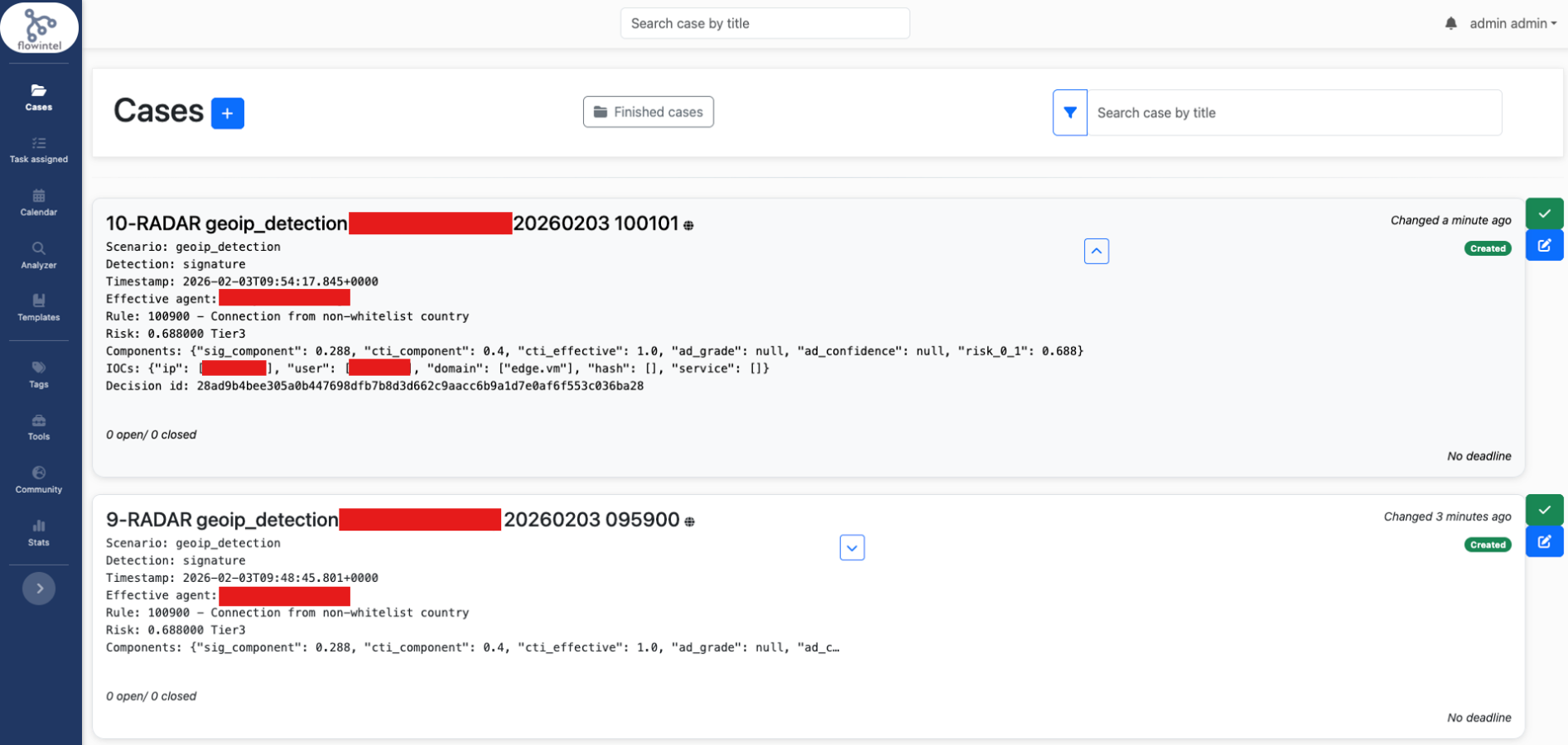
Test case step 3: The FlowIntel case is created in the Cases menu in FlowIntel defined in FLOWINTEL_BASE_URL address.
- 0 = flawless: FlowIntel case created.
Defect summary description
Successful test execution, i.e., defect category: 0 = flawless
Text execution evidence
See linked files (if any), e.g., screenshots, logs, etc.
Comments
Any additional informative details not fitting in the above sections.
Guide
- Defect category: 0 = flawless; 1 = insignificant defect; 2 = minor defect; 3 = major defect; 4 = critical defect
- Verification method (VM): Test (T), Review of design (R), Inspection (I), Analysis (A)
Parent links: TST-059 Non-whitelist GeoIP detection validation
| Attribute | Value |
|---|---|
| test-date | 2026-02-03 |
| tester | AAT |
| defect-category | 0 = flawless |
| passed-steps | 3 |
| failed-steps | 0 |
| not-executed-steps | 0 |
| release-version | 0.7 |
| verification-method | T |